






JWST: Supernova Revelation
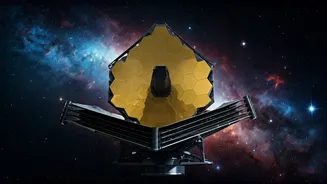
The James Webb Space Telescope (JWST) has played a pivotal role in confirming the existence of the oldest known supernova ever observed. This remarkable
discovery links to the Gamma-Ray Burst (GRB) 250314A, offering valuable insights into the early universe. The JWST's capacity to observe in infrared allows it to peer through cosmic dust, unveiling events from the universe's nascent stages that were previously hidden from view. The identification and study of such early supernovae give researchers a clearer understanding of stellar evolution and the formation of the first galaxies. The confirmation significantly expands our understanding of the universe's history and offers new avenues for exploration.
Galaxy Collisions and Black Holes
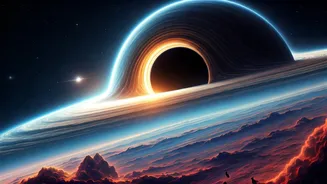
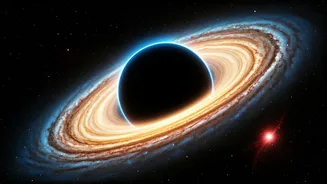
Recent data reveals that the merging of galaxies can trigger the activation of supermassive black holes. Using data from the Euclid telescope, astronomers have observed a strong correlation between galaxy collisions and the activity of these cosmic giants. When galaxies merge, the gravitational disruptions can funnel vast amounts of gas and dust towards the central black holes, causing them to grow and release massive energy in the process. These findings offer a deeper understanding of how supermassive black holes influence the evolution of galaxies and their environments. The Euclid data provides crucial evidence that galaxy mergers are a significant mechanism behind the activation and growth of these colossal black holes, impacting galactic structures and dynamics.
Frame-Dragging Confirmed
Astronomers have also confirmed Einstein's theory of frame-dragging, a concept predicted over a century ago. By observing the wobbling orbit of a star around a black hole, scientists have validated Einstein's prediction. Frame-dragging occurs when a massive rotating object, such as a black hole, drags spacetime around with it. The star's orbit is influenced by the spacetime distortion caused by the black hole's rotation. This confirms that gravity acts not only as a force but also as a warp in spacetime, where massive objects drag the very fabric of the universe. This observation offers some of the most compelling evidence to support Einstein's theories and demonstrates their relevance in understanding the behavior of objects within extremely strong gravitational fields.