
Theia's Unexpected Encounter
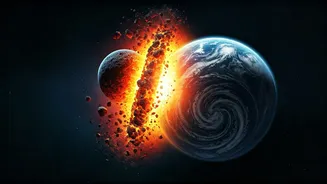
The conventional wisdom states that the moon formed from a massive impact between the early Earth and a Mars-sized celestial body, Theia. This collision,
occurring roughly 4.5 billion years ago, remains a central tenet of planetary science. The impactor, Theia, was thought to have been completely destroyed or largely integrated into Earth. The debris from this violent collision eventually coalesced, forming the moon. Recent studies continue to refine our understanding of this cataclysmic event, using sophisticated computer models and analyses of lunar samples to understand the formation process. This research aims to understand the precise nature of the collision, exploring variables like the angle of impact and the composition of Theia.
Simulations and Surprises
Scientists utilize complex simulations to model the Theia impact scenario. These models consider factors like the size and speed of the impacting bodies. They also account for the composition of both Earth and Theia. New studies use these simulations to reveal the intricate mechanics of the collision. They suggest that a significant portion of Theia's material might have remained in orbit. This material subsequently came together to create the moon. The simulation outcomes have sparked debates within the scientific community. They underscore the need for further research, including more advanced modeling techniques and new methods of analyzing lunar samples to provide more insight into the process.
Lunar Composition Clues
Analyzing the moon’s composition plays a crucial role in validating the Theia impact theory. Scientists study lunar rocks and soil to determine their isotopic ratios. This can reveal the origins of the moon's material. The similarity between the isotopic composition of Earth and the moon has presented a persistent puzzle. The most recent data from the lunar samples suggest that the moon is mostly formed from the Earth, which means that Theia had a smaller role. These findings have led to questions. Some scientists suggest that Theia and Earth might have been similar in composition. Others theorize that the collision mixed the materials so thoroughly that differences became indiscernible.
Evolutionary Perspective of Moon
The moon’s formation significantly impacted Earth's evolution. The moon stabilized Earth's axial tilt, which helped create a more stable climate. The moon's gravitational influence created tides, which may have played a part in the development of life in the early oceans. Furthermore, the moon's presence protected Earth from numerous impacts by asteroids and other space debris, making Earth a safer place for complex life. Therefore, the study of the moon and its origin provides deep insights into the early stages of Earth and into the conditions that supported the emergence of life.
The Road Ahead
Researchers continue to develop refined models of the Theia impact. They also intend to collect more data from lunar missions. The goal is to obtain new insights into the moon's origin. Future missions will collect more lunar samples. They will analyze them with improved equipment. New data will help refine the impact models and resolve ambiguities about the exact source of the moon's material. The scientific exploration of the moon's origin not only enhances our understanding of the solar system's formation. It also offers potential clues about other planets and the conditions that might lead to the emergence of life beyond Earth.