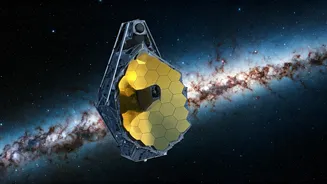

Unveiling Dark Matter
Dark matter, making up a significant portion of the universe's mass, remains largely undetectable by conventional means. It doesn't interact with light,
making it 'dark.' Its presence is inferred through its gravitational effects on visible matter, such as galaxies and stars. Scientists have long sought methods to directly observe or understand dark matter, believing that it holds crucial information about the universe's structure and evolution. The JWST, with its advanced infrared capabilities, promises a new approach to this challenge. It allows researchers to study the cosmic background radiation in unprecedented detail, which could hold subtle clues about dark matter's distribution and behavior. It is believed that the JWST will improve our understanding of the distribution of dark matter and its impact on cosmic structures.
JWST's Unique Advantage
The JWST operates primarily in the infrared spectrum, allowing it to penetrate cosmic dust and observe the early universe. This is important because dark matter's effects are most pronounced in the early universe, where gravitational forces shaped the first galaxies. The telescope's sensitivity enables the detection of faint signals from the distant past, potentially revealing the influence of dark matter on the distribution of early galaxies and other structures. Its high resolution provides the means to scrutinize the effects of dark matter on the warping of light from distant objects, a phenomenon known as gravitational lensing. By observing this distortion, scientists can create detailed maps of dark matter distribution in the cosmos. This could also help identify specific locations where dark matter is most concentrated, furthering research on its characteristics. It is also important to note that JWST's instruments are finely calibrated to measure these subtle effects with unparalleled precision, which promises to revolutionize our understanding of dark matter.
Gravitational Lensing Details
Gravitational lensing is a key tool in this quest. When light from distant galaxies passes by massive objects like dark matter concentrations, it is bent and amplified due to gravity. The JWST's instruments can analyze this bent light to reveal the presence and distribution of dark matter. By studying the patterns of light distortion, scientists can map the dark matter's locations and density. This provides a three-dimensional view of dark matter in the universe, helping researchers to understand how dark matter has influenced the growth and distribution of galaxies over cosmic time. The degree of the light distortion can also offer insights into the nature of dark matter particles themselves. Precise measurements of the lensing effects could constrain the possible properties of dark matter, offering key clues about its identity. Gravitational lensing has already proven useful and will continue to be a primary focus of JWST observations.
Potential Breakthroughs Ahead
The potential breakthroughs of using JWST to study dark matter are numerous. Scientists anticipate that JWST can confirm or refute theoretical models about dark matter's nature, such as whether it is composed of weakly interacting massive particles (WIMPs) or axions. The data collected could also provide new constraints on alternative dark matter candidates. Discoveries made through the JWST's infrared observations could reveal the detailed structure of the early universe, which holds clues about dark matter's role in the formation of cosmic structures. JWST could provide a novel way to detect dark matter and allow for the creation of maps detailing its distribution throughout the cosmos. This may help in finding potential locations for the direct detection of dark matter particles using other experimental techniques. The telescope might reveal structures and phenomena that were previously hidden, offering unprecedented insights into the universe's most mysterious component.