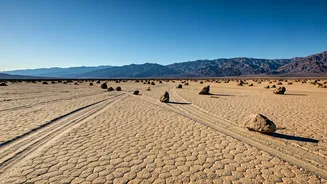

A Desert Enigma
Death Valley, renowned for its scorching temperatures and arid landscape, also harbors a geological enigma: the sliding rocks of Racetrack Playa. These
rocks, ranging in size from pebbles to massive boulders, leave behind distinct trails on the otherwise flat playa surface. For years, scientists and enthusiasts alike have been captivated by the mystery of how these rocks move without any visible external force. The paths they carve are often long and winding, suggesting a gradual, yet unexplained, movement. Theories abounded, from unseen hands to magnetic forces, but none could fully account for the observed behavior of these peculiar rocks and their mysterious journeys across the desert floor. The stark, barren environment adds to the intrigue, with the lack of vegetation and the intense sun highlighting the trails, making the phenomenon even more prominent and puzzling.
Ice and Wind Dance
The puzzle has finally been solved thanks to dedicated research. The key lies in a rare combination of conditions. First, the playa needs to be flooded with shallow water, allowing ice to form. As temperatures drop below freezing, a thin layer of ice forms around the rocks. Subsequently, the formation of this ice sheet plays a crucial role. When the ice sheet is sufficiently thin, it's easily moved by the wind. Finally, strong winds, common in Death Valley, exert force on the ice, which in turn pushes the rocks. This gentle push, combined with the slippery ice surface, allows the rocks to glide across the muddy surface, leaving the telltale trails behind. The interplay of these factors must occur at the same time to create the movement. It provides a credible explanation for the long-standing mystery.
Rare Conditions Unite
The conditions that drive the sliding rocks are quite specific, thus explaining why the phenomenon is so rare. The presence of shallow water is critical for ice formation. This means only periods of heavy rainfall or flooding can trigger rock movement. Also, the temperature must drop just right to create thin, floating ice sheets that are easily moved by the wind. Too warm, and no ice will form. Too cold, and the ice gets too thick, preventing movement. Finally, the wind speed must be optimal. Gentle breezes won’t do, as strong gusts are needed to actually move the ice sheet, which then nudges the rocks. The delicate balance among these factors accounts for the infrequency with which the sliding rocks actually move. This helps to explain why the movement of the rocks is so infrequent and so difficult to predict.
Long-Term Monitoring
The scientists used a variety of monitoring methods to observe the movement of the rocks. Time-lapse photography, GPS tracking, and weather data collection were integral to the research. Cameras were set up to capture the movements over an extended period. The use of GPS provided accurate data about the rock paths, and the accompanying weather data helped to correlate movement with wind speeds and temperatures. This multi-pronged approach allowed the researchers to gather comprehensive data, documenting the exact environmental conditions under which the rocks slide and providing proof that ice and wind are indeed the primary forces involved. This thorough and sustained monitoring approach delivered the insights needed to finally solve the mystery of Death Valley's sliding rocks and their mysterious travels.
Scientific Significance
The study's findings have important implications for other research areas. The insights gained from the Death Valley phenomenon also provide valuable insights into how other geological processes work. This is particularly relevant to how extreme environments shape landscapes. By better understanding the mechanisms at play in Death Valley, scientists can more accurately interpret the geological history of the region and understand the impact of climate change. Moreover, the study exemplifies how basic scientific inquiry, even into seemingly unusual phenomena, can provide significant information regarding fundamental physical and environmental processes. This, in turn, helps refine scientific understanding and improve the ability to forecast geological behavior under varied climate conditions.