
Hidden Rainfall Unveiled
Scientists have recently identified a previously unknown rainfall pattern that could have profoundly influenced the climate of the Horn of Africa. This
pattern might be responsible for cycles of prolonged dry and wet periods in the region. The discovery could lead to a deeper understanding of historical climate shifts and provide clues for better farming practices.
Ancient Water Reservoirs
Recent studies suggest that the Earth's deep interior may have once held a significantly larger volume of water than previously thought. This ancient reservoir could have played a crucial role in the planet's geological evolution. The findings challenge current models of Earth's formation and the distribution of water. Further research in this area could provide valuable insights into our planet's early history and the conditions necessary for life.
Europa's Spider Scar
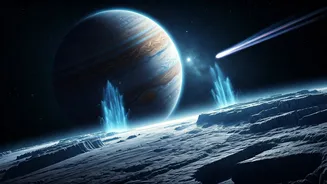
The unique spider-like scar on Jupiter’s moon, Europa, has captured the attention of scientists, who believe it may indicate the presence of subsurface salty water. The presence of this briny water could dramatically increase the likelihood of finding conditions that could potentially support life. This discovery fuels the ongoing exploration of Europa and highlights the possibility of habitable environments beyond Earth. Researchers continue to analyze the data to better understand the composition of this moon.
Exoplanet Atmosphere Uncovered
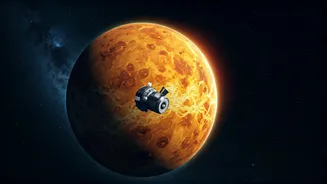
Astronomers have discovered a thick atmosphere on an ultra-hot rocky exoplanet, TOI-561 b. This exoplanet orbits a star located thousands of light-years away. This finding indicates that it is possible for rocky planets, which are similar in size and composition to Earth, to retain substantial atmospheres even under extreme conditions. The research provides valuable information about the diversity and habitability of exoplanets.
Solar Neutrinos Observed
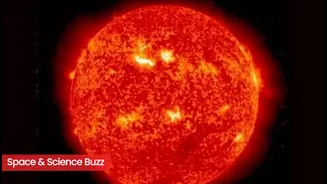
Scientists have, for the first time, observed solar neutrinos altering matter. Neutrinos are fundamental particles that can pass through matter almost unaffected, however, this study reveals how they can undergo changes under specific conditions. This provides new insights into neutrino physics and strengthens our understanding of the fundamental forces in the universe. This finding is of great importance to astrophysicists.
Einstein's Frame Dragging
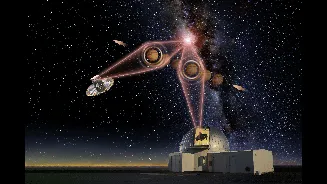
Astronomers are utilizing recent observations to confirm Einstein’s theory of frame dragging. They are observing the wobbling orbit of a star to observe the effects of gravity on a massive object. This study enhances our understanding of general relativity, and supports the idea of how massive bodies interact. The work will continue to confirm this theory by studying the movements of celestial bodies.
Ancient Comet Insights
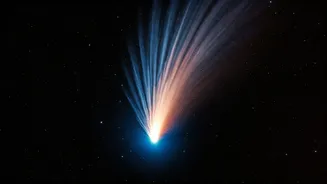
Scientists are studying the ancient interstellar comet 3I/ATLAS to gain insights into the formation of early star systems. By analyzing the comet's composition, they hope to unlock clues about the building blocks of planets. This research could illuminate how our solar system formed and provide hints of other planets.