
Unveiling Cosmic Imbalance
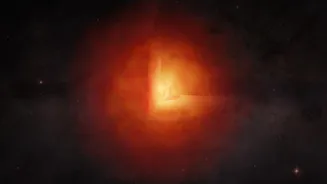
Recent studies have brought forth the notion that the universe might not be as uniform as previously conceived. This proposition introduces a captivating
twist to our current understanding of cosmology. Current cosmological models often work on the premise of a universe that's consistent in its properties across vast stretches of space. However, if this new research is validated, the very basis of these models might require a reevaluation. The implications of this discovery could touch upon the distribution of matter and energy, affecting the cosmic microwave background's behavior. The concept of an asymmetrical universe encourages scientists to explore the universe in a new way, searching for deviations and imbalances that could reshape our knowledge of the cosmos. Further research and observation are essential to understand this cosmic puzzle and its wider impact.
Questioning Cosmological Models
The research suggesting a lopsided universe poses a direct challenge to the fundamental assumptions underpinning contemporary cosmological models. These models typically rely on the cosmological principle, which asserts that the universe, on a large scale, is homogeneous and isotropic, meaning it appears the same everywhere and in all directions. If the universe shows signs of asymmetry, this principle becomes questionable. Scientists would have to rework their models. They will likely need to adjust the parameters of the models or develop new theories to accommodate observations that suggest a non-uniform distribution of matter and energy. This could lead to a deeper understanding of the universe's origin and evolution. Such a shift compels the need for an elaborate reassessment of how we understand the cosmic structure.
Impact of Lopsided Universe
If the universe is indeed lopsided, its impact could be wide-ranging and significant. For example, the distribution of galaxies and galaxy clusters could reveal unexpected patterns, challenging our understanding of how cosmic structures formed and evolved. The behavior of dark matter and dark energy, the mysterious components that dominate the universe's energy density, could also be affected. The study of the cosmic microwave background, which is the afterglow of the Big Bang, might show unexpected variations. These variations could point towards an imbalance. Furthermore, such discoveries could stimulate new avenues of research. These new avenues of research could possibly give more knowledge to the fundamental laws governing the universe. It underscores that our understanding of the universe is still evolving. Researchers must embrace innovation when exploring the mysteries of the cosmos.
Ongoing Investigations & Future
The journey to ascertain whether the universe is lopsided is far from over. This research introduces a new direction for cosmologists. They are employing advanced techniques and observational tools to investigate these concepts further. Telescopes and sophisticated analytical methods are key tools. These tools are used to gather data and look for the evidence of asymmetry. Researchers are also constructing simulations. These simulations help in testing various scenarios and refine their understanding of how such asymmetries could arise. These efforts are expected to continue for years, if not decades, as they search for new data and evaluate complex theories. The exploration into the universe's potential lopsidedness will undoubtedly reshape our understanding of cosmic evolution. It will push the boundaries of current knowledge and fuel further scientific breakthroughs.