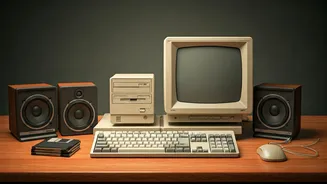







The Desktop's Dominance
In the 1990s, the desktop computer reigned supreme, evolving from a niche technology to a household staple. Keyboards were clunky, often featuring a distinct
click with each keystroke, and mice were attached by cords. The monitors, significantly larger than today's sleek designs, relied on cathode-ray tubes (CRTs), which produced a distinct flicker. Internal components, such as the CPU and RAM, were continuously improving, which lead to higher processing speeds and the ability to run more complex software. The operating systems of the time, predominantly Windows-based, became more user-friendly, expanding the user base of personal computing. The overall impact was widespread, as computers became a source of work, entertainment, and communication.
The Mighty Floppy Disk
Floppy disks were a ubiquitous storage solution in the 90s. These small, square plastic cases held a magnetic disk that stored data. They were essential for transferring files, as internet speeds were slow and USB drives did not yet exist. The standard 3.5-inch floppy disk, with a capacity of 1.44MB, was an important part of everyday computing. They were relatively unreliable, often prone to damage, and their limited capacity forced users to split large files across multiple disks. The iconic sound of a floppy disk being inserted and accessed became a familiar noise in homes and offices across the world. They were phased out with the advent of CDs, zip disks and then USB drives.
The Internal Modem Marvel
The internal modem was a key component that allowed computers to connect to the internet via telephone lines. They were mostly 56k, and used the RJ-11 phone connector to establish a connection with an Internet Service Provider (ISP). The familiar sound of the modem dialing up, with its series of beeps and squeals, was a constant when accessing the internet. Surfing the web or checking emails was a slow process, due to the limited bandwidth. The internal modem represented a major technological advancement, offering a convenient way to access the internet from the comfort of your home. This technology was phased out with the advent of broadband internet.
The External Speakers
In the 1990s, external speakers greatly improved the sound experience on computers. Early computer systems had weak built-in speakers, and so it was desirable to amplify the output from the PC. People could now enjoy music, games and multimedia files in a better way. The quality of the speakers ranged from basic to high-end, depending on the budget. Speakers were connected to the computer via a 3.5mm audio jack, and were available in a range of sizes and designs. These speakers were vital in enhancing the multimedia experience during the 90s.
Dot Matrix Printers
Dot matrix printers were widely used during the 90s. They used pins to strike an ink ribbon against paper, creating characters in a dot pattern. Though slower and noisier than other printer types, dot matrix printers were known for their reliability and low running costs. Dot matrix printers were suitable for printing text documents and reports. These printers played a crucial role in home and office setups. However, they were gradually replaced by inkjet and laser printers which offered better quality and faster printing.
The Joy of Joysticks
Joysticks, essential for gaming on computers, were a must-have accessory. From arcade games to early 3D adventures, the joystick was the dominant control device. Joysticks provided a tactile experience, letting players feel in control. They came in many shapes and sizes, from basic single-button models to more complex designs. With the advent of more sophisticated games, joysticks became even more elaborate. The joystick remained a staple of computer gaming throughout the 90s, helping to shape the video games experience.
CD-ROM Drives
CD-ROM drives made it easy to use software and multimedia content. CD-ROMs could hold far more data than floppy disks and offered significantly faster data transfer speeds. Games, software, and multimedia content were frequently distributed on CD-ROMs. Installing software and running games became quicker and easier. The CD-ROM drive was an important part of the 90s computing environment.
The Rise of Sound Cards
Sound cards greatly improved the audio capabilities of computers during the 90s. Early PCs had limited sound capabilities, mostly using beeps and basic tones. Sound cards, like the Sound Blaster series, introduced better sound quality. Sound cards could output complex audio, which made playing games and listening to music an exciting experience. The installation of a sound card was necessary for enjoying the advancements of gaming and multimedia. Sound cards made PCs capable of handling complex sound.