








Europa's Intrigue
Europa, a moon of Jupiter, has long fascinated scientists due to its potential for harboring life. Beneath its icy shell, there's a global ocean, a liquid
water environment that could potentially support life as we know it. The presence of water is a fundamental requirement for life. The research aims to understand the moon's subsurface ocean, which might be similar to Earth's oceans, containing essential elements and energy sources. The recent discovery of a spider-like feature on Europa's surface has piqued scientists' curiosity, potentially offering insights into the composition of Europa's hidden ocean. This specific formation may be linked to subsurface activity, giving clues about the composition and physical characteristics of the moon's internal structure. Further investigation into this formation could give valuable details, including water composition and how its hidden ocean interacts with the ice shell.
Scar’s Curious Details
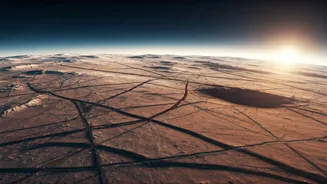
The spider-like scar on Europa's surface is a key focus of the ongoing research. Scientists are analyzing the structure and origin of this formation, which may be tied to the subsurface ocean and associated with geological activities. The scar's characteristics, like its intricate pattern and potential relationship to the moon's internal structure, will be analyzed. Such details might include the presence of minerals, salts, and the nature of water, as well as the potential for hydrothermal activity. The examination may reveal if there are fractures or faults which bring the internal ocean material up to the surface. It will help to understand the material's composition and the possible presence of life-supporting elements. The study of the spider-like structure aims to understand the dynamics between Europa's internal ocean and icy crust, potentially helping to understand how geological processes shape its surface.
Subsurface Oceans Explored
Exploring Europa’s subsurface ocean is a key goal. Scientists utilize various methods to study the hidden ocean, including remote sensing techniques and data analysis from spacecraft missions. Researchers gather information about the ocean's depth, salinity, temperature, and composition. The presence of salts, minerals, and organic compounds, along with geological activity, may provide essential clues about the possibility of life. Analysis includes examining the properties of water, the presence of hydrothermal vents, and the potential interactions between the ocean and Europa's icy shell. The research teams aim to learn more about the ocean’s depth, as well as its geological activities and the potential for life. This exploration relies on a combination of different techniques to acquire detailed and comprehensive knowledge.
Implications for Life
The research on Europa has far-reaching implications for the search for life beyond Earth. If the subsurface ocean contains the ingredients for life, such as water, essential elements, and energy sources, it could significantly boost the possibility of finding extraterrestrial life. The study of Europa's geological processes and composition provides valuable insights into the habitability of other icy moons and planets in our solar system. Learning more about the Europa's ocean will provide information that might be crucial in planning future missions to explore Europa and search for signs of life. The findings may reshape the way we look for life in the universe, which helps to further our scientific understanding of habitability and how life forms elsewhere in the cosmos.