
Witnessing Cosmic Drama
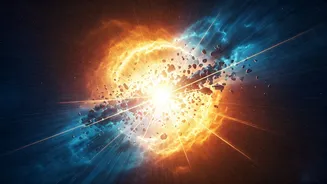
The Hubble Space Telescope, a symbol of scientific advancement, provided a stunning view of a collision in a nearby planetary system. These systems, not
unlike our own, are dynamic environments. This particular incident, carefully observed by astronomers, presented an exceptional opportunity to study the processes of planet formation in action. The data collected provides crucial insights into the formation of planets in the universe. This observation provided tangible evidence and strengthened the scientific community's understanding of how planetary systems evolve from swirling disks of gas and dust into organized configurations of planets, moons, and asteroids. This observation validated and advanced existing theories about how planets come to be.
Hubble's Observational Power
Hubble's capabilities are pivotal in providing the clarity necessary to analyze distant cosmic events. Its advanced instrumentation allowed astronomers to collect detailed data on the composition and movement of the materials involved in the collision. These observations were vital to understand the scale and velocity of the impacting objects, providing further insights into the force of the event. The instruments used by Hubble could detect the light emitted and reflected by the colliding objects, which would help researchers construct an image of the event and provide clues about its nature. Such detailed information cannot be found through ground-based telescopes and proves the importance of space-based observatories. This data gathering helped to provide a comprehensive picture of the events.
Violent Planet Formation
The collision provided a snapshot of the often-violent nature of planetary formation. The event, observed by the Hubble Space Telescope, served as a case study. The early stages of planet development are considered chaotic, with massive impacts shaping the evolution of young systems. The collision observed was most likely the result of two large celestial bodies crashing into each other. The aftermath of such impacts is usually a disk of debris, which eventually could coalesce into new planetary bodies, according to the standard model of planetary formation. Studying these impacts is critical for researchers as it allows them to see the creation of planets, offering important insights into the origins of our own solar system.
Einstein's Theory Confirmed
Astronomers have for the first time observed a black hole twisting spacetime, validating Einstein's theory of general relativity. These observations were possible because of the development of advanced technology. The data confirms the predictions of Einstein's theory and offers scientists new tools for probing the behaviour of these mysterious objects. The observation has the potential to help researchers understand gravity, and the fundamental structure of the universe, and how matter behaves in extreme environments. Confirming these predictions reinforces the validity of Einstein's theory and highlights the significance of continued exploration of the cosmos.
Beyond the Immediate Impact
The implications of this cosmic collision reach beyond just one planetary system. Astronomers will use this data to refine models of planetary formation across the cosmos. This could enable us to better understand the conditions necessary for planets to form and potentially to support life. The ongoing study of such events continues to unravel the mysteries of the universe, informing future space missions and theoretical explorations. This event underscores the dynamic nature of space and the ongoing process of discovery.