



Dark Matter Cloud
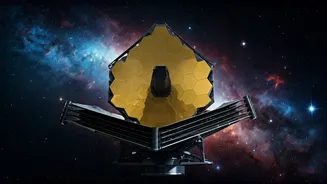
Hubble's recent observations brought to light a peculiar dark matter cloud devoid of any stars. This discovery is particularly significant because it challenges
established cosmological models. Dark matter, although unseen, constitutes a large part of the universe's mass. The observation of a starless cloud offers an exceptional opportunity to study the characteristics and actions of dark matter, offering scientists fresh avenues to scrutinize its distribution and interactions within the universe. The Hubble Telescope's capability to detect faint signals has proved essential in uncovering this mysterious celestial formation, presenting new challenges and opportunities for theoretical physicists and astronomers.
Betelgeuse's Companion
In addition to the dark matter cloud, Hubble also captured the wake of a hidden companion star associated with Betelgeuse, a well-known red supergiant star. This finding confirmed a long-standing theory that Betelgeuse has a previously undetected companion. This discovery provided concrete evidence supporting the theoretical models concerning the interactions between stars, revealing details about the evolution of binary star systems. The telescope's precise observation capabilities allowed for the detailed study of the aftermath of Betelgeuse's companion, enhancing our understanding of stellar dynamics and the final stages of a star's life. The detailed imaging of the wake will assist in refining existing models and help predict the future of binary star systems.