





Hubble's Galactic Gaze
The Hubble Space Telescope, a collaboration between NASA and the European Space Agency, continues to provide groundbreaking images of space. Recently,
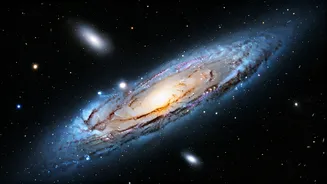
Hubble turned its attention to the spiral galaxy NGC 4388, located within the Virgo galaxy cluster. This cluster, home to numerous galaxies, makes for a dynamic environment where galaxies interact. The image captured by Hubble shows something quite remarkable: gas escaping from NGC 4388. These images were taken with Hubble's Wide Field Camera 3. The data and resulting image provide essential clues about the processes taking place within galaxies and their surroundings. Such observations are critical for understanding how galaxies grow, evolve, and affect their environments over billions of years. Hubble’s ability to capture these intricate details allows scientists to study galaxies at various stages of their lives, providing key insights into the universe's history and future.
Gas Ejection Explained
The phenomenon of gas escaping a galaxy, as seen in NGC 4388, is an essential process in the evolution of galaxies. This gas, primarily composed of hydrogen, is the raw material from which stars are born. When gas is ejected from a galaxy, it changes the way new stars are formed, impacting the galaxy's overall star-forming rate and its eventual appearance. Several factors contribute to this gas ejection. Powerful winds generated by massive stars, supernovae explosions, and interactions with other galaxies within a cluster can all drive gas outwards. In NGC 4388, the specific mechanism likely involves a combination of these factors. Detailed analysis of the Hubble images helps scientists identify the drivers of this gas outflow, such as the location and intensity of star formation or the presence of an active galactic nucleus. Understanding these processes is crucial for modeling galaxy evolution and how galaxies change over time, giving astronomers a comprehensive understanding of the universe's past, present, and future.
Virgo Cluster's Influence
The location of NGC 4388 within the Virgo galaxy cluster is pivotal to understanding the galaxy's current state. The Virgo cluster is a very dense environment, meaning galaxies within it are packed together, increasing the likelihood of gravitational interactions and collisions. These interactions can trigger star formation, strip gas from galaxies, or even disrupt their structure. The cluster also contains a hot, diffuse gas that can strip gas from galaxies moving through it. NGC 4388's interaction with this hot gas is a likely cause of its gas ejection. The gravitational forces from other galaxies in the cluster can also contribute to this outflow. By studying the gas escaping from NGC 4388, astronomers can study the effects of environmental interactions on galaxies. The cluster environment has a great impact on the evolution of galaxies residing in it, influencing how they grow, form stars, and evolve over cosmic timescales. Observing such phenomena helps astronomers understand how galaxies change across the universe.
Hubble's Scientific Impact
Hubble’s observations of NGC 4388 contribute significantly to our broader understanding of galaxy evolution. These observations allow astronomers to test and refine models of galactic processes, such as star formation, gas dynamics, and environmental influences. The detailed images from Hubble provide crucial data about the physical properties of galaxies, including the distribution of gas, the presence of dust, and the rate of star formation. This information is combined with data from other telescopes, like the James Webb Space Telescope, to build a more complete picture of galaxy evolution. The multi-telescope approach allows astronomers to observe galaxies at different wavelengths, each revealing distinct characteristics and processes. The synergy of different space-based and ground-based observatories helps scientists investigate the complex interplay of forces that shape galaxies over cosmic time. These insights will help scientists understand how the universe has evolved.