
Floppy Disks: Data Storage
In the early to mid-1990s, the floppy disk, a square casing housing a magnetic storage medium, was the primary method for saving and transferring data.
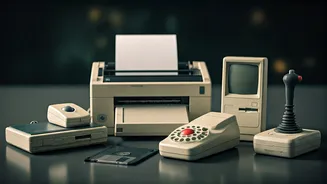
These flexible disks, typically 3.5 inches in size, held a then-substantial 1.44 MB of data. They were essential for installing software, sharing files, and backing up important documents. The floppy disk's design included a metal shutter to protect the magnetic surface, and the infamous 'save' icon was modeled after it. They were widely used by everyone; from students to professionals. The widespread adoption of floppy disks made them a crucial part of the computing experience. The disks' limited capacity, however, soon became a bottleneck as software and file sizes increased. This led to the emergence of Zip drives and other higher-capacity storage options towards the end of the decade.
Dial-Up Modems: Internet Access
The dial-up modem was the gatekeeper to the internet in the 90s, connecting computers to the nascent World Wide Web. These devices, which connected via telephone lines, produced the iconic screeching and beeping sounds as they established a connection. The speed of these modems was a snail's pace compared to today's standards, with initial speeds of 14.4 kbps and later reaching 56 kbps. Internet surfing often involved long wait times for pages to load, and using the internet meant tying up the home phone line. Despite the limitations, dial-up modems were revolutionary and gave rise to the age of the internet for many households. The dial-up experience became a shared cultural phenomenon, and marked the start of the digital age.
Dot Matrix Printers: Printing Power
Dot matrix printers were the workhorses of the 1990s, offering a cost-effective solution for printing documents. These printers functioned by striking pins against an ink ribbon to create characters and images on paper. They were known for their distinctive noise, and the quality of their print was basic, suitable for text-based documents but less so for graphics. Dot matrix printers were popular for invoices, reports, and other documents that didn't demand high-resolution output. They became essential in homes and offices. Despite their noisy operation and modest print quality, dot matrix printers provided affordable printing solutions. Though the technology is now considered outdated, it was a practical choice in its time.
CD-ROM Drives: Software Distribution
The CD-ROM drive signaled a significant advance in data storage. CDs could hold far more data than floppy disks. Software, games, and multimedia content were increasingly distributed on CDs, making them essential. CD-ROM drives became standard in the mid-1990s, marking the decline of the floppy disk as the primary storage medium. They enabled the emergence of complex software. The ability to play music CDs on computers also enhanced their appeal, making them a center of multimedia. The evolution of CD-ROM drives to faster speeds and the eventual advent of CD-R and CD-RW technologies further broadened their use. CD-ROM drives became a symbol of the shift to a digital world.
External Hard Drives: Storage Backup
External hard drives represented a leap forward in storage capacity and data backup solutions in the 1990s. While not as common as other accessories early in the decade, they gradually became more prevalent as file sizes increased. External hard drives provided a convenient way to store large amounts of data, which included large software installations, personal files and media, and to back up important documents. Many external drives connected via parallel ports. These external hard drives made data backup and portability easier. While internal hard drives remained essential, external drives became indispensable for anyone needing a reliable backup solution. The growth of external hard drives marked a shift towards larger data volumes, and their value has only increased over time.
Trackballs: Mouse Alternatives
Before optical mice dominated the market, trackballs offered an alternative input method. Often found in older desktop setups and on laptops, trackballs gave users a different way to control the cursor. Users moved the cursor by rolling a ball with their thumb or fingers. Trackballs offered the advantage of not needing any desk space, but they had their disadvantages, such as the need to clean the ball. Despite their limitations, they were popular. Trackballs provide an insight into the variety of technologies of the period. Though they are not common now, trackballs have left a mark on computing's evolution.
Sound Cards: Audio Experience
Sound cards transformed the audio experience on computers in the 1990s. Before sound cards, the beeps and simple sounds were common. Sound cards enhanced the multimedia experience by providing high-quality audio playback and support for more complex sound effects. The cards like the Sound Blaster series were particularly popular, offering compatibility with games. Sound cards, in conjunction with the growth of CD-ROM drives, transformed computers into multimedia centers. Games became richer. Sound cards were a sign of the technological changes that were altering the way people used computers. These cards helped drive the explosion in entertainment and content creation during that time.