







What Is a CME?
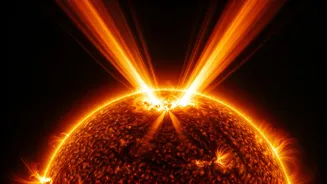
Coronal mass ejections, or CMEs, are enormous bursts of plasma and magnetic field ejected from the Sun's corona. The sun's corona is the outermost layer
of its atmosphere. These powerful events are capable of causing significant disturbances in space weather near Earth, sometimes disrupting communication and navigation systems. Stellar flares and CMEs are common occurrences in active stars. They are linked to changes in a star's magnetic field and are capable of releasing vast amounts of energy, often far more than what our own Sun can unleash. Understanding these events on other stars allows astronomers to evaluate the habitability of exoplanets in their vicinity. These observations help provide insights into the behavior of stellar systems.
Distant Star Phenomena
Observing CMEs on distant stars is challenging, which makes this detection a remarkable feat. Astronomers use telescopes and specialized instruments to study the light from these stars and search for events, which may signify explosive activity. The analysis of the light variations, as well as the wavelengths associated with such events, can help researchers deduce the occurrence of a CME. Stellar CMEs, in contrast to our sun's CMEs, are known to have a greater impact, especially around younger stars, potentially stripping away planetary atmospheres and drastically altering planetary climates. This is a critical area for astronomers investigating exoplanet habitability. The new discovery could potentially change current models of star and planet interactions.
Impact and Future Research
The observation of a CME on a distant star provides crucial insight into the potential impacts these events can have on exoplanets. Stellar CMEs are incredibly powerful, and understanding their influence is important for assessing if exoplanets are capable of supporting life. Such events could erode the atmospheres of exoplanets, making them inhospitable. Future research will likely focus on gathering data about how CMEs may be linked to stellar activity cycles and how their power varies among different types of stars. Also, future investigations should focus on how astronomers might better understand the nature of such events. This includes exploring exoplanets that can withstand the effects of CMEs and the conditions that might influence their ability to foster life.
Implications for Exoplanets
The detection of a CME on a distant star has important implications for exoplanets, which are planets orbiting stars other than our own Sun. The CME’s energy can significantly impact these exoplanets. The discovery could affect our search for life beyond our solar system. The presence of CMEs and their severity can influence a planet's ability to maintain an atmosphere and retain water, which are two key factors for sustaining life as we understand it. Astronomers will use this knowledge to evaluate the habitability of exoplanets, assess the risk to those planets, and improve models to estimate the conditions in which life might occur elsewhere in the galaxy.