AI's Transformative Role
Artificial Intelligence is increasingly stepping into the shoes of scientists, fundamentally altering the way research is conducted. Traditional laboratory
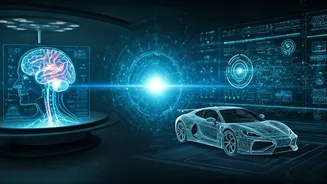
processes, often time-consuming and prone to human error, are being reimagined through AI-powered automation. The AILA lab at IIT Delhi is a prime example of this evolution. They are developing AI systems capable of designing experiments, analyzing data, and even generating hypotheses. This shift not only streamlines research but also opens doors to faster discoveries. This new era of scientific exploration, driven by AI, can free up researchers to focus on more complex aspects of their work. The AI handles the mundane tasks, providing scientists with more time for strategic thinking and innovation. This collaboration between humans and machines promises to accelerate the pace of scientific advancement. These advancements are contributing to the democratization of science, by making complex experimentation available with reduced resources. AI's capabilities allow for the exploration of new data sets and the generation of insights that might be missed by human analysts.
Automating Lab Processes
One of the major impacts of AI is the automation of lab processes. AI can control and monitor instruments, optimize experimental conditions, and collect data with remarkable precision. This automation reduces human involvement, minimizing errors and enhancing the reproducibility of results. The AILA lab is developing AI systems that can execute entire experimental workflows autonomously. This allows for a significant increase in the throughput of experiments, enabling scientists to test more hypotheses in a shorter period. AI's capabilities extend to predictive analysis, enabling scientists to anticipate outcomes and adjust experiments accordingly. With machine learning models, AI can analyze vast datasets to identify patterns and correlations that might otherwise remain hidden. This can help researchers to refine their experiments and accelerate the process of discovery. This means that scientific breakthroughs can occur faster, saving time and money, and allowing research teams to explore more avenues than ever before. AI also makes complex experiments less labor-intensive, allowing scientists to focus on higher-level analytical tasks.
Data Analysis Revolutionized
The ability to analyze vast amounts of data is another critical aspect of AI's contribution to scientific research. Traditional data analysis, with its dependence on manual methods, often becomes a bottleneck in the research process. AI can process and interpret complex datasets much faster and more accurately. The AILA lab's AI systems can sift through enormous volumes of data, identifying key trends, and generating meaningful insights that would be difficult to discern through manual analysis. AI is particularly effective in identifying subtle patterns and correlations that can point to important scientific breakthroughs. By automating the data analysis process, AI accelerates the discovery phase and allows researchers to spend more time interpreting results and formulating new questions. AI tools are also adept at detecting and correcting errors in datasets, ensuring the reliability of research findings. This data-driven approach is enhancing the accuracy and efficiency of scientific investigation, paving the way for faster and more reliable scientific progress. This ensures that researchers are making decisions based on thorough, evidence-based analysis.
Faster Discovery, Deeper Insights
The combination of AI's capabilities in automation and data analysis leads to faster discoveries and deeper insights. By automating routine tasks and rapidly analyzing data, AI frees up scientists to concentrate on higher-level thinking and problem-solving. This allows them to focus on the interpretation of results and the development of new hypotheses. The impact of AI on scientific research is not just about speed; it's about the quality and depth of the insights generated. The AILA lab is creating AI tools that can identify previously unknown connections and patterns in scientific data. The ability to explore these connections can unlock new avenues of research. The integration of AI into labs also means that experiments can be designed with greater precision. AI-powered simulations can help scientists to optimize experimental parameters before physical experimentation begins. This can reduce the time and resources required for each experiment. By providing faster insights and deeper understanding, AI is reshaping the landscape of scientific discovery, leading to more impactful and innovative research.
The Future of Research
The future of scientific research is intrinsically linked to the ongoing advancements in Artificial Intelligence. The work being done by institutions like IIT Delhi's AILA lab points towards a future where AI and human scientists collaborate to achieve remarkable breakthroughs. As AI technology continues to improve, its ability to support and enhance scientific work will expand. This collaborative approach promises to transform the way we understand the world. We can expect to see AI playing an even larger role in all areas of scientific endeavor. The integration of AI into research labs requires a shift in mindset. Scientists will need to learn new skills to work with AI tools. Those with a strong scientific background and an aptitude for working with technology will lead the transformation. As AI becomes more sophisticated, its capabilities to support and enhance scientific work are sure to expand. This collaboration will likely lead to ground-breaking advances. It will also foster greater collaboration between scientists and AI developers. Ultimately, AI is poised to revolutionize the way we conduct scientific research.