






Fusion Power Dawn
The landscape of energy generation is undergoing a dramatic shift at the former Bull Run Fossil Plant in Claxton, Tennessee. After decades of powering
the region through coal, the site's iconic twin smokestacks have been dismantled, making way for a revolutionary endeavor. This initiative, spearheaded by a company supported by Bill Gates, centers on an ambitious fusion energy project named Infinity One. The company has taken a significant regulatory step, submitting its initial major licensing application to state authorities on January 29, 2026. Collaborating closely with the Tennessee Valley Authority (TVA), this project aims to replicate the immense power source of the sun, marking a pivotal moment in the quest for sustainable energy solutions and a departure from fossil fuel dependence.
The Stellarator Secret
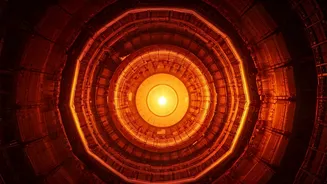
Infinity One distinguishes itself from conventional nuclear power by harnessing fusion, the very process that ignites stars. Unlike traditional nuclear fission plants that split atoms, fusion involves merging light atomic nuclei. This atomic union releases colossal amounts of energy. The specific technology being employed is known as a stellarator, an intricate device that utilizes powerful magnetic fields to contain and manage plasma. Plasma, a superheated gas existing at approximately 100 million degrees Celsius, is a state of matter crucial for fusion reactions. This extreme temperature enables atomic nuclei to fuse. While tokamaks, doughnut-shaped fusion devices, are more widely discussed, stellarators offer a distinct approach. They employ complex, twisted magnetic coils to maintain plasma stability over extended periods, addressing a common challenge faced by tokamaks which can experience instability issues, though stellarators are inherently more complex to construct.
Regulatory Milestone Reached
The recent licensing submission in Tennessee represents a significant regulatory advancement for fusion energy. In 2023, the U.S. Nuclear Regulatory Commission established a new framework, deciding that fusion energy systems would not be regulated under the same stringent rules as traditional nuclear power plants. Instead, they are to be governed by the byproduct materials framework, a system also applied to facilities like particle accelerators and medical radiation units. This regulatory shift reflects a broader recognition of fusion's inherently lower risk profile compared to fission. Officials from Type One Energy, TVA, and Tennessee state regulators have been diligently collaborating since early 2024 to prepare this foundational application. The primary objective is to demonstrate that the project's design adheres to all essential safety and environmental standards.
Coal's Successor Dawns
Should the Infinity One project gain approval and proceed with construction, it would achieve a dual distinction: becoming Tennessee's inaugural commercial fusion power venture and symbolizing a profound transition at the Bull Run site. This evolution marks a definitive shift from relying on coal-fired electricity to embracing an experimental, next-generation energy system. While the project remains in its nascent stages, its current trajectory clearly indicates a commitment to pioneering advanced energy technologies. The site, once synonymous with coal, is now charting a course toward a cleaner, more sustainable energy future powered by the principles of fusion, a testament to innovation and forward-thinking energy strategies.