







Orbital Data Centers Explained
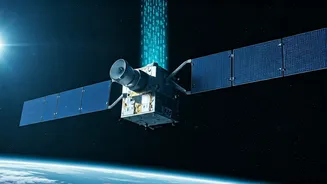
An orbital data center represents a significant evolution in satellite capabilities, moving beyond simple data transmission to in-orbit computation. These
are essentially constellations of satellites equipped with powerful Graphics Processing Units (GPUs), similar to those found in terrestrial data centers. The key innovation is the ability to train and execute complex Artificial Intelligence (AI) models directly in space, rather than relying solely on sending raw data back to ground stations for processing. This approach bypasses the limitations of conventional satellites that typically use low-power 'edge' processors for tasks like signal compression. Applying the principle of edge computing—performing computation close to the data source—to orbit promises to unlock much more demanding tasks. Pixxel's Pathfinder satellite is designed as a single-satellite demonstrator to rigorously test the resilience of ground-grade hardware in the challenging orbital environment, aiming to achieve reliable functionality in low Earth orbit.
Global Interest Ignites
The concept of orbital data centers has recently captured the attention of major global technology firms due to a convergence of critical factors. Traditional ground-based data centers are facing increasing constraints related to energy availability, land use, water resources, and local regulatory hurdles, all of which have been exacerbated by the escalating demands of AI development. In contrast, space offers a compelling alternative: continuous solar power, effectively providing free and abundant electricity, which is a primary driver for migrating computation into orbit. Furthermore, Earth observation satellites generate vast amounts of detailed image data that are costly to download to Earth. Processing this data in orbit and transmitting only the derived insights could significantly alleviate these bandwidth bottlenecks. Competitive positioning also plays a role, with companies like SpaceX, Amazon's Blue Origin, and Microsoft Azure Space actively exploring or deploying pilot projects in this domain, signaling a race to establish a commercial-scale orbital data center presence.
Challenges of Space Computing
Operating powerful computing hardware in space presents distinct environmental challenges that require innovative engineering solutions. A primary concern is thermal management: while space is cold, its vacuum prevents convection, the primary heat dissipation mechanism on Earth. This means GPUs generate heat that cannot be easily dissipated, essentially becoming self-contained ovens. The solution involves intricate systems that pump heat through ammonia-filled loops to deployable panels, where it can be radiated into space as infrared light. Another significant hurdle is radiation. Cosmic rays can cause 'bit flips' (random changes in computer data) and long-term degradation of semiconductor components. While radiation-hardened chips are used in space hardware, they typically lag behind commercial GPU technology by several years. Additionally, ensuring power availability during eclipse periods necessitates robust energy storage, and the impossibility of on-orbit maintenance requires extensive built-in redundancy from the outset.
Pixxel-Sarvam Partnership Details
The collaboration between Pixxel and Sarvam focuses on developing and launching the Pathfinder satellite, which will serve as India's first orbital data center. Pixxel, a specialist in imaging satellites, is responsible for the satellite's design, construction, launch, and operational management. Sarvam, an Indian AI firm, provides the critical AI infrastructure, enabling the deployment of full-stack language models that can be trained and utilized on the satellite's onboard GPUs. This integrated approach means that hyperspectral imagery captured by Pixxel's advanced camera can be analyzed directly in orbit. The outcome of this analysis—the conclusions drawn from the data—will then be transmitted to Earth, streamlining the data downlink process. While specific details regarding the number of GPUs, launch costs, and the chosen launch provider (with options including ISRO and SpaceX) remain undisclosed, Pixxel has assembled a team with significant expertise in space technology and thermal management.
Cost and Future Prospects
Currently, the notion of data crunching in space being cheaper than on Earth is not a reality, according to available evidence. A single satellite equipped with GPUs represents a higher initial capital investment compared to equivalent hardware on the ground. However, the long-term economic viability hinges on several assumptions: the eventual scaling of satellite constellations to tens of thousands, a significant reduction in launch costs facilitated by operational systems like SpaceX's Starship, and the offset of cooling and grid-power expenses in orbit against the initial outlay. Proponents, like Pixxel's CEO, anticipate this parity within a 5-10 year timeframe, suggesting that 100-500 satellites could eventually replace a terrestrial data center. Independent assessments, however, offer a more conservative outlook, deeming edge processing on satellites viable in the near term but viewing a wholesale replacement of terrestrial cloud infrastructure as a 10- to 30-year proposition.