






JWST's Cosmic Gaze
The James Webb Space Telescope (JWST) has rapidly become an essential tool in contemporary astronomy, capable of observing light from the earliest stages
of the universe. Unlike traditional telescopes, JWST operates in the infrared spectrum, allowing it to see through cosmic dust clouds and observe distant objects. This capability is particularly important in the study of dark matter, a mysterious substance that makes up approximately 85% of the universe's mass but does not interact with light. Scientists use JWST to study how galaxies form and evolve, especially focusing on those that formed in the early universe, as these formations are believed to be heavily influenced by dark matter. The data collected provides insights into the distribution and behavior of dark matter within these galaxies, helping to refine existing models and theories. JWST's advanced instruments are designed to detect the faint signals emitted by these distant galaxies, thereby providing the data needed to understand how dark matter affects the structure and evolution of the universe.
Galaxies: A Dark Matter Stage
JWST's observations of early galaxies offer fresh insights into how dark matter shapes cosmic structures. These early galaxies, existing billions of years ago, are key to understanding the early universe's dynamics. JWST's high-resolution capabilities allow it to detect subtle variations in the distribution of dark matter within these galaxies. This data is critical for validating current models of dark matter, which predict how it clumps together to form the gravitational scaffolding on which galaxies are built. One crucial aspect of this research involves studying the rotation curves of galaxies. Scientists can analyze the speed at which stars and gas orbit the galactic center. If the observed rotation speeds deviate from what is predicted based on the visible matter alone, it offers concrete evidence for the presence of dark matter. JWST's detailed imaging also helps in finding unusual galaxy formations, such as those that might have formed due to interactions with dark matter. These discoveries can help refine our understanding of the properties of dark matter, such as its interaction cross-section and its distribution across the universe.
Black Holes as Clues
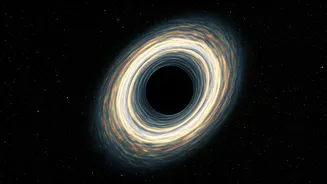
Supermassive black holes, found at the centers of most galaxies, also provide clues to dark matter’s behavior. JWST's ability to observe the environment around these black holes is particularly advantageous. Astronomers are using the telescope to investigate how dark matter might influence the growth and activity of these black holes. The gravitational pull from dark matter could affect how gas and dust are drawn into the black holes, thereby influencing the radiation output. The JWST is also being used to study the jets of particles that are ejected from these black holes, which may interact with surrounding dark matter. Observations of these jets and the areas around black holes provide information about the density and distribution of dark matter within galaxies. These findings give vital details about how dark matter and supermassive black holes jointly affect cosmic development. Moreover, understanding this relationship is key to understanding the formation and evolution of galaxies over cosmic time.
Dark Matter Models
The data from JWST is critical for assessing and refining dark matter models. Scientists have developed various theoretical models to explain the nature of dark matter, and these models make specific predictions that can be tested against observational evidence. These models range from the popular Weakly Interacting Massive Particles (WIMPs) to more exotic possibilities. JWST's ability to observe the early universe and detect faint signals from distant galaxies lets scientists compare observations with these theoretical models. For example, some models predict that dark matter should clump together more or less strongly than others, and JWST can measure this clumping through galaxy distribution analysis. The data provided by JWST is already helping to eliminate or adjust existing models. JWST’s data helps refine dark matter’s properties, such as its mass and interaction strength. JWST also encourages new ways of thinking about dark matter, leading to a more complete view of the universe.
Future Discoveries
The journey with the James Webb Space Telescope has only just begun. Its ongoing observations promise to yield new data and insights, continually refining our knowledge of dark matter. Further research will focus on studying the early universe, where dark matter’s influence was most prominent. This involves observing even more distant galaxies and searching for signs of the first dark matter structures. Another important area of research involves looking at the interaction between dark matter and ordinary matter. These interactions could be detected through subtle signals, like distortions in the light from distant galaxies. As JWST continues to gather data, astronomers anticipate finding new evidence that challenges current understandings. This may lead to new models and hypotheses that will transform our views of the universe. The future of dark matter research, powered by the incredible capabilities of the James Webb Space Telescope, is filled with the promise of exciting discoveries.