
Dance and Robots
The research, a collaboration between scientists at the University of Maryland, Baltimore County (UMBC), discovered a novel application of Indian dance.
The study indicated that the intricate hand movements, known as mudras, found in classical Indian dance, could be utilized to provide more intuitive and efficient control over robotic hands. The research looked at the ways these gestures are able to precisely convey meaning and movement, thereby providing a blueprint for mimicking human dexterity in machines. It's a fusion of ancient cultural practices and modern technological capabilities, providing a distinctive method to enhance the interaction between humans and robots, particularly in intricate tasks.
Mudras: The Key
Mudras, the very essence of Indian classical dance, are not merely aesthetic movements; they have a rich symbolic language that is capable of communicating complex emotions and ideas. Each mudra, carefully defined and executed, represents a specific meaning or narrative element. The UMBC study revealed how these detailed gestures could provide very clear and unambiguous instructions to robotic hands. The key is in translating the complex hand positions into specific instructions that a robot can understand and act upon. This gives robots a nuanced approach to hand movements, mimicking the elegance and precision found in human interactions.
Better Hand Dexterity
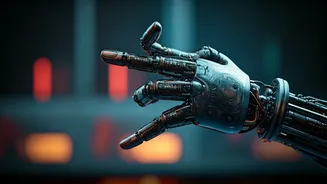
Traditional robotic hands often struggle with the versatility and complexity of human hand movements. By integrating mudras into the control systems, researchers have developed a model for improving robotic dexterity significantly. This enables robots to carry out complicated tasks that are typically challenging for them, such as delicate object manipulation or tasks requiring fine motor control. In essence, the study provides a means for enhancing a robot's ability to imitate human hand movements, thereby improving its functionality in a variety of uses, from intricate manufacturing processes to the sensitive realm of surgical interventions.
Potential Applications
The potential applications of the mudra-based robot control are widespread and diverse. In the field of medicine, robots can be used in complex surgical procedures, giving surgeons more precision and control, while also reducing the invasiveness of surgeries. The manufacturing industry can benefit from robots capable of handling small, intricate components with more skill, raising productivity and precision. Additionally, this technology has applications in industries requiring the handling of hazardous materials, where robotic hands could take the place of humans. The integration of ancient dance forms and modern technology has sparked the imagination of researchers, resulting in numerous possible uses.
Future Research
The UMBC study marks only the beginning of a larger exploration into the possibilities of this unique combination. Future research will likely concentrate on refining the translation process of mudras into robotic instructions, which will require the creation of more sophisticated algorithms and sensors. Additionally, researchers may concentrate on expanding the repertoire of mudras that can be used to control robots, potentially providing an even wider range of motion and capabilities. The research might also investigate the possibility of using machine learning to enable robots to learn and adapt to various mudras, which could further improve their dexterity and versatility. The integration of technology and cultural practices has created a wide field for innovation, with implications for a number of fields.