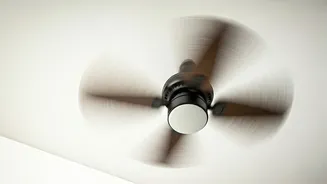









Motion Perception Explained
Our visual system doesn't capture every single position of a fast-moving object. It works in a series of snapshots, piecing together the movement like
a flipbook. When we look at a spinning fan, we don't perceive each individual blade position. Instead, our brains fill in the gaps between the frames, creating a sense of continuous motion. This process is complex, involving our eyes' photoreceptor cells, which convert light into electrical signals, and the brain, which processes these signals to understand what we're seeing. The speed of the fan plays a critical role here. If the fan is spinning slowly, we can clearly see the individual blades. However, as the speed increases, our ability to track them individually diminishes.
The Stroboscopic Effect Unveiled
The seemingly backward motion of a fan is largely due to a phenomenon called the stroboscopic effect. This effect occurs when a rapidly rotating object is viewed under intermittent light, such as a flickering light source or even the 'frames' of our visual system. Imagine the fan blades like the spokes of a wheel. As the fan spins, a frame of our vision 'catches' the blades in a particular position. If, in the next frame, the blades have rotated slightly backward from where we expect them to be, our brain interprets this as backward motion. This is because the brain assumes the shortest distance between the viewed positions is the true direction of movement. Thus, the illusion of reverse rotation occurs.
Visual System's Limitations
Our eyes have limitations when processing very rapid movements. The brain's processing speed and the retina's ability to capture images contribute to this effect. The retina has light-sensitive cells that detect light and color and convert these into electrical signals. When an object moves quickly, the brain may misinterpret the sequence of these signals, leading to the illusion of reversed movement. Furthermore, the persistence of vision plays a crucial role. This means our eyes retain an image for a fraction of a second after it's gone, creating a blur effect for fast-moving objects. This blur can also contribute to the illusion, especially if the fan's speed is close to the critical speed where the reversal is noticeable.
Lighting's Impact on Perception
The type of lighting significantly affects the perception of the fan's motion. Continuous light, like sunlight or a steady incandescent bulb, makes it less likely to see the reverse-motion effect. However, if the light flickers, such as under fluorescent lights or even from some LED sources, the stroboscopic effect becomes more pronounced. This is because the intermittent light acts as a series of 'snapshots,' capturing the blades at specific points. The frequency of the flicker compared to the fan's speed can drastically change how the movement is interpreted. For instance, a flicker rate that aligns perfectly with a slight backward movement of the fan blades between snapshots will reinforce the illusion of a reversed spin.