






Cosmic Sling for Asteroid
NASA's ambitious Psyche spacecraft is on an extraordinary mission to reach a peculiar asteroid composed primarily of metal. To conserve precious fuel and
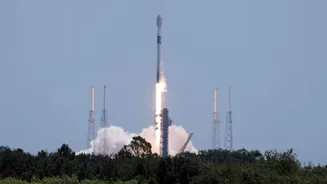
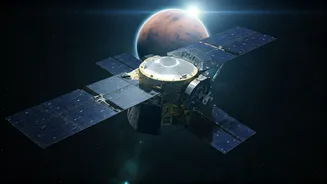
precisely adjust its trajectory, the mission is leveraging a critical gravitational assist from Mars. This strategic flyby, scheduled to occur at an altitude of approximately 2,800 miles (4,500 kilometers) above the Martian surface, will see the spacecraft traveling at a remarkable speed of about 12,333 mph (19,848 kph). The encounter utilizes the immense gravitational pull of the Red Planet to accelerate Psyche and steer it on its extensive voyage towards the asteroid belt. Launched in October 2023, Psyche relies on advanced solar-electric propulsion, using xenon gas to gradually build momentum. By incorporating this planetary gravity assist, mission engineers significantly reduce the need for onboard propellant, ensuring the spacecraft has enough power for its extended journey. Furthermore, these close encounters with planets serve as vital opportunities for the mission team to rigorously test and calibrate the spacecraft's sophisticated systems and scientific instruments before its ultimate arrival at the asteroid.
Martian Observations En Route
While en route to its primary target, the Psyche spacecraft will engage in significant scientific observation during its close pass by Mars. The operations team has planned to utilize the spacecraft's multispectral imager to capture thousands of detailed images and gather valuable data about the Red Planet. These observations are not merely for show; they are crucial for refining the techniques that will be employed once Psyche begins its orbital study of the asteroid Psyche, anticipated in late 2029. The mission has already begun sharing early, unprocessed images, revealing distant starfields with Mars appearing as a small point of light. Future processing of these flyby images will involve adjustments to brightness and contrast, with the team aiming to assemble a captivating time-lapse sequence of the entire event. This flyby also serves as a critical practice session for the imager's 'satellite search' capabilities, a function that will be vital for later identifying potential moonlets around the asteroid Psyche. Beyond imagery, other instruments are poised to contribute valuable data. Psyche's magnetometer will meticulously record the interaction between Mars' magnetic field and solar particles, while the gamma-ray and neutron spectrometer will monitor fluctuations in cosmic rays as the spacecraft navigates this unique segment of its mission.
Trajectory Refinement and Support
To ensure the success of the crucial Martian flyby, meticulous planning and execution are paramount. The mission team conducted a precise trajectory correction maneuver on February 23, involving a 12-hour thruster firing. This operation was designed to fine-tune Psyche's approach path and impart a slight velocity increase, setting the stage for its arrival at Mars. Mission planning lead Sarah Bairstow confirmed that the spacecraft is precisely on course and that all flight operations for May have been programmed into its flight computer. This encounter presents a unique chance to calibrate Psyche's imager with a celestial body much larger than a few pixels, alongside observations from other scientific instruments. The Deep Space Network (DSN) will play a pivotal role in monitoring the mission, tracking radio signals exchanged between Psyche and Earth to confirm the flyby's successful completion. Any subtle changes in the spacecraft's velocity will be detected through the Doppler shift in these signals, enabling engineers to promptly ascertain Psyche's revised trajectory as it departs Mars. To further bolster the mission's observational capabilities, several other spacecraft currently operating at Mars will provide crucial support. These include NASA's Mars Reconnaissance Orbiter, Mars Odyssey orbiter, Curiosity rover, and Perseverance rover, all contributing observational and navigation data. Additionally, ESA's Mars Express and ExoMars Trace Gas Orbiter will participate in supporting the flyby. By cross-referencing Psyche's data with that from these established Martian missions, scientists can achieve enhanced calibration of Psyche's instruments, a crucial step for the mission's scientific integrity.