





Orbital Hazards Unveiled
Low Earth Orbit (LEO) is densely populated with satellites, making it a crucial space for communication, navigation, and scientific research. However,
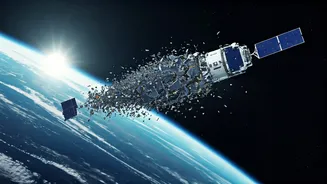
this region faces a growing threat from space debris, consisting of defunct satellites, rocket stages, and fragments from collisions. This debris orbits Earth at incredible speeds, posing a significant risk. Even small pieces of debris can cause catastrophic damage upon impact with operational satellites. The more debris there is, the higher the risk of collisions, which in turn generate even more debris, leading to a dangerous cycle known as the Kessler syndrome. This escalating cycle poses a risk of rendering LEO unusable, potentially within a few years if unchecked.
The Kessler Syndrome Threat
The Kessler syndrome, a scenario first proposed by NASA scientist Donald Kessler, describes a situation where the density of objects in LEO reaches a critical point. In this scenario, collisions between objects become frequent enough to generate new debris faster than it can be removed, leading to a cascade of collisions. The result is a runaway effect, where the debris cloud grows exponentially, making the region increasingly hazardous. This phenomenon could render LEO inaccessible for future satellite launches or even manned missions. The cascading effect could potentially happen in a relatively short timeframe, turning a valuable space into a dangerous zone for humanity's presence in space.
Triggering Orbital Disaster
The potential for an orbital disaster depends on several factors. A single, high-energy collision between two large objects, for instance, could trigger a cascade. The impact would generate a significant amount of new debris, which would increase the likelihood of subsequent collisions. A malfunctioning satellite that explodes, or an accidental collision with a piece of space junk, could also be a trigger. Furthermore, the increasing number of satellites being launched adds more targets for potential collisions, amplifying the problem. The specific combination of circumstances that could start the cascade is difficult to predict, which makes it challenging to pinpoint the exact moment when a runaway effect will take hold.
A 2.8-Day Warning?
The “2.8 days” in the title doesn't necessarily mean that a catastrophic event is imminent. Rather, it emphasizes the potential speed at which the Kessler syndrome could take hold once a critical threshold is crossed. This timeframe serves as a stark reminder of how rapidly the situation can deteriorate once a runaway chain reaction begins. The precise speed of the cascading effect is still a topic of scientific debate, depending on factors like debris distribution, satellite density, and collision probabilities. Some models suggest that the initial phase of a cascade could unfold quickly, emphasizing the need for proactive intervention.
Safeguarding Space Assets
Mitigating the threat of orbital collapse involves a combination of strategies. One crucial step is to reduce the creation of new space debris by designing satellites to minimize the risk of explosion or fragmentation. This includes using materials that are less likely to break apart and implementing de-orbiting mechanisms so that defunct satellites can be removed from orbit. Another critical measure is active debris removal, meaning the physical removal of existing debris from orbit. This can be achieved through various technologies, such as robotic arms, nets, or harpoons, to capture and de-orbit large pieces of debris. International collaboration is also important as space debris doesn't respect national boundaries. A coordinated global approach to debris mitigation and removal is essential to preserve the space environment.
International Cooperation Needed
Addressing the orbital debris problem requires worldwide cooperation among spacefaring nations. International agreements and guidelines are necessary to promote responsible behavior in space and to share the costs and responsibilities of debris mitigation and removal efforts. This also involves the establishment of clear space traffic management rules to prevent collisions and to improve the tracking and monitoring of space objects. Space agencies and organizations from different countries must share data, develop joint projects, and coordinate their strategies to protect the space environment for future generations. The united approach is critical in tackling this global issue, as a safe LEO benefits all countries and the planet as a whole.