







Quantum Power Unveiled
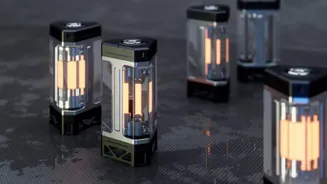
The realm of energy storage has been dramatically impacted by the creation of the world's first functional prototype of a quantum battery. This pioneering
device, developed by a collaboration of Australian institutions including CSIRO, The University of Melbourne, and RMIT, operates on principles far removed from conventional chemical reactions. Instead, it harnesses the peculiar laws of quantum mechanics to store and release energy, marking a significant scientific achievement. This prototype has successfully demonstrated the complete cycle of charging, retaining energy, and then discharging it, a feat previously confined to theoretical discussions. It represents a tangible step towards a completely new paradigm in how we power our technologies, moving beyond the limitations of current battery designs.
The Quantum Charging Edge
The fundamental difference between quantum batteries and their everyday chemical counterparts lies in their energy transfer mechanism. Rather than relying on electrochemical processes, quantum batteries utilize light and sophisticated quantum interactions. A truly remarkable characteristic of these quantum devices is their ability to accelerate charging speed as their size increases, a phenomenon attributed to "collective effects." Essentially, integrating more quantum cells enhances the charging rate, a direct inverse to the performance of standard batteries where adding more units typically leads to diminished returns in charging speed. This counterintuitive scalability offers a compelling advantage for future energy solutions, suggesting larger quantum batteries could become incredibly efficient for rapid power replenishment.
Instantaneous & Remote Power
The current iteration of the quantum battery prototype showcases astonishing performance metrics, capable of completing a full charge in a mere femtosecond—that's one quadrillionth of a second. Powering this marvel is a laser system that wirelessly converts light directly into electrical energy. This elegant mechanism not only facilitates ultra-fast charging but also unlocks the exciting potential for remote power transmission. Researchers envision a future where devices like drones, and even vehicles, could be recharged while in motion, completely eliminating the need for physical plugs or charging pads. This capability to deliver energy wirelessly and remotely represents a significant leap toward truly untethered technological experiences.
Future Challenges Ahead
While the concept of a quantum battery is revolutionary, its practical application in consumer electronics like smartphones or laptops is still a distant prospect. The existing prototype, though demonstrating incredible speed, can only store a minuscule amount of energy and its charge dissipates within nanoseconds. The primary hurdles for widespread adoption are to substantially augment both the energy storage capacity and the duration for which the charge can be maintained. Until these challenges are overcome, quantum batteries are more likely to find initial utility in specialized domains, such as the demanding environment of quantum computing, where their unique properties can provide distinct benefits. Nevertheless, the long-term implications of this technology are profound, hinting at a future where perpetual power without the need for conventional charging might become a reality.