





Ejection: Winds vs Jets
Black holes, despite their immense gravitational pull, aren't entirely passive. They actively interact with their surroundings through the ejection of
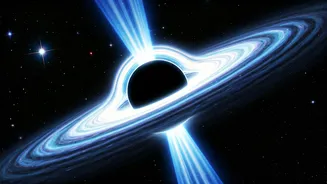
material, which primarily takes two forms: winds and jets. Cosmic winds are broad, diffuse streams of gas that move outward from the vicinity of the black hole, creating a sweeping effect. In contrast, jets are highly focused, collimated streams of particles that are expelled along the black hole's axis of rotation, reaching incredible speeds and distances. These jets can extend far beyond the black hole's immediate environment, playing a significant role in shaping the surrounding galaxy. The type of ejection, wind or jet, is linked to the accretion process, as well as the black hole's properties such as its spin and the amount of material it's consuming. Understanding the interplay between these outflows is vital for grasping how black holes influence their galactic environments.
Accretion's Role Defined
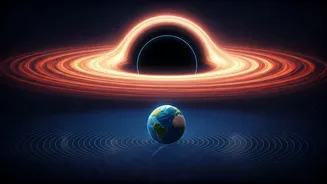
The process by which a black hole 'feeds' – accretion – plays a critical role in determining whether it will produce winds or jets. Accretion involves the accumulation of material, such as gas and dust, falling towards the black hole. As this material spirals inward, it forms an accretion disk, a swirling structure around the black hole. The characteristics of this disk, including its density, temperature, and magnetic field strength, strongly influence the nature of the outflow. If the accretion disk is dense and relatively cool, the black hole is more likely to generate powerful winds. Conversely, if the accretion disk is less dense and hotter, and is also coupled with strong magnetic fields, it becomes more likely that the black hole will launch highly energetic jets. The type of inflow impacts the outflow mode, and is dependent on properties of the black hole and its feeding process.
Wind-Driven Galactic Impact
Black hole winds can significantly affect their host galaxies. These winds, consisting of material propelled outward from the black hole, can push away vast amounts of gas and dust. This process, often referred to as 'feedback,' can suppress star formation. By expelling the raw materials needed for new stars, winds regulate the growth of galaxies, influencing their size and structure. The force of the wind can also compress the interstellar medium, which will lead to the formation of new stars in other regions of the galaxy. Therefore, black hole winds are not just an outflow of matter; they act as a crucial mechanism that shapes the evolution of entire galaxies. Their sweeping action is central to understanding the balance of star formation within a galactic system, and the overall morphology of galaxies over cosmic timescales.
Jet-Induced Galaxy Sculpting
Jets, the other major form of black hole ejection, have a different, but equally profound, impact on galaxies. These highly collimated streams of particles, traveling at near-light speeds, can travel through the intergalactic medium and transfer enormous amounts of energy over vast distances. The energy deposited by jets can heat and ionize the gas within the galaxy, which can also influence star formation. Jets can also influence the motion of the interstellar gas and alter its distribution throughout the galaxy, changing its structural features. In some cases, the jets can even 'blow out' material from the galaxy, contributing to the overall feedback process. Their high speed and concentrated energy allow jets to carve out regions in the galaxy and influence the distribution of energy and matter.
The 'Cosmic Seesaw' Paradox
An intriguing observation is that black holes tend to eject material as either winds or jets, but not both simultaneously. This is where the 'cosmic seesaw' analogy comes in, emphasizing that these two outflow modes appear to be mutually exclusive. If the black hole is producing winds, it typically won't be generating jets, and vice versa. The physics behind this is complex, involving the interactions between the accretion disk, magnetic fields, and the black hole's spin. The precise mechanisms that trigger one form of outflow and suppress the other are a subject of ongoing research. The presence of winds or jets, therefore, is an indication of the black hole's state, providing clues about its feeding rate, the properties of the material it is accreting, and the environment in which it resides.
Black Holes: Galactic Architects
The combined effects of winds and jets suggest that black holes are not merely passive objects. Instead, they actively shape their galactic environments. The interplay between these ejection processes, the accretion disk, and the surrounding interstellar medium creates a complex feedback loop. This loop helps determine the evolution of a galaxy over billions of years. Black hole outflows regulate star formation, influence the distribution of gas and dust, and determine the overall structure and appearance of galaxies. The study of these outflows offers deeper insights into the intricate interplay of forces that govern the evolution of galaxies, and the role that supermassive black holes play in the cosmos.