




Distant Cosmic Explosion
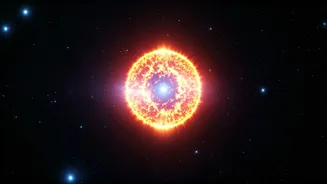
Scientists utilizing the James Webb Space Telescope (JWST) have achieved a monumental feat by identifying the most remote supernova ever detected. This
extraordinary event is intrinsically linked to the gamma-ray burst (GRB) designated as 250314A, which had its origins in the early days of the universe. The JWST's capacity to perceive infrared light, which allows it to peer through cosmic dust, was instrumental in this discovery. The findings from this investigation have substantial implications, providing astronomers with insights into the nature of supernovae, the processes of star formation, and the fundamental composition of the early universe. This discovery underscores the crucial role of advanced technology in furthering our understanding of cosmic phenomena occurring over vast spatial and temporal scales.
GRB 250314A Connection
The supernova discovered by JWST is intricately connected to the gamma-ray burst (GRB) labeled 250314A. Gamma-ray bursts are among the most energetic events in the cosmos, frequently associated with the explosive deaths of massive stars, or perhaps the merger of neutron stars. GRB 250314A, a powerful surge of gamma rays, originated from a distant galaxy, with the supernova appearing as a subsequent event following the burst. Astronomers posit that the supernova may be the afterglow or a secondary event linked to the death of the star that initially triggered the gamma-ray burst. The precise correlation between the burst and the supernova provides an exceptional opportunity to study the physical characteristics of these events, helping researchers create models on the evolution of stars and galaxies in the earliest epochs of the universe.
Unveiling Early Universe
The discovery of this distant supernova is particularly significant because it offers a glimpse into the early universe. By studying objects so far away, scientists are, in effect, looking back in time, witnessing events that took place billions of years ago. This allows them to investigate the conditions under which the first stars and galaxies formed. Supernovae play a pivotal role in the formation of heavy elements, essentially acting as cosmic factories. The JWST's observations of this distant supernova are expected to improve understanding of how these elements were dispersed throughout the early universe, contributing to the formation of future stars, planets, and even the ingredients necessary for life. This discovery exemplifies the transformative power of modern space telescopes in expanding the boundaries of our cosmic comprehension.