





Dark Matter's Enigma
Dark matter, although unseen, is a crucial element in understanding the structure and evolution of the universe. It interacts gravitationally with visible
matter, shaping galaxies and galaxy clusters. Scientists estimate that dark matter constitutes approximately 85% of the total mass of the universe, yet its composition remains unknown. Several theories propose potential candidates, with axions emerging as one of the most promising. These hypothetical particles, born from theoretical physics, are considered to be weakly interacting and very light, thus making their direct detection particularly challenging. The mystery surrounding dark matter fuels extensive research efforts, employing innovative technologies to unveil the universe's hidden components. Understanding dark matter is crucial, not only to comprehend the cosmos' structure, but also to potentially revise fundamental physics models.
Haloscopes: Dark Matter Hunters
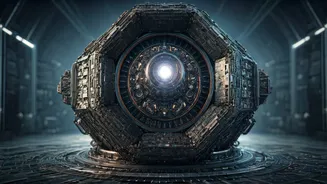
Haloscopes represent a class of detectors specifically designed to seek out axions. These sophisticated instruments operate on the principle that axions, if they exist, might convert into photons (particles of light) within strong magnetic fields. A haloscope typically comprises a resonant cavity, often a metallic cylinder, placed within a powerful magnetic field. The cavity is finely tuned to resonate at specific frequencies. If axions are present, they interact with the magnetic field, generating photons at a frequency related to the axion's mass. This extremely faint signal is then amplified and analyzed to determine if the axion exists and identify its properties. The sensitivity of haloscopes heavily relies on advancements in quantum technology, including ultra-low-noise amplifiers and high-precision measurement techniques. Researchers are continuously enhancing these technologies to increase their capability to detect the elusive axions.
Sharpening the Search
Current research is focused on refining the search for axions by exploring higher frequencies. Since the axion's mass determines the frequency of the photons produced, targeting higher frequencies is essential to cover a broad range of possible axion masses. This is a formidable undertaking, as it requires the development of highly sensitive detectors capable of operating at these frequencies. The ongoing research efforts involve designing and constructing new haloscopes with improved characteristics, such as enhanced magnetic field strengths, lower-noise amplifiers, and more precise tuning capabilities. By probing the higher frequency ranges, scientists hope to discover axions that might have evaded previous detection efforts and gather more precise information about the axion's existence and properties. This advancement could provide crucial information about the nature of dark matter.
Quantum Technology's Role
Quantum technology plays a critical part in enhancing the sensitivity of haloscopes. These technologies make it possible to measure extremely faint signals, which is vital for detecting the subtle conversion of axions into photons. For example, quantum-limited amplifiers are designed to amplify signals without adding significant noise, thus improving the overall signal-to-noise ratio of the detection system. Quantum sensors are being developed to improve the precision of measurements and offer greater control over various parameters. Another promising avenue is the use of superconducting circuits to build highly sensitive resonant cavities. Quantum computing might have a future role in analyzing the enormous amounts of data collected by these experiments. These advancements are vital for advancing the search for axions and other forms of dark matter.
Future Prospects Unveiled
The continued exploration into axions using haloscopes holds great potential for a clearer understanding of dark matter and fundamental physics. Successful detection of axions would constitute a monumental breakthrough, confirming the nature of dark matter and validating the theoretical models that predicted them. Further, it would likely prompt a paradigm shift in our knowledge of the universe. Current research indicates continuous enhancements in haloscope design and data-analysis techniques. The ultimate goal is to map the distribution of dark matter across the universe and examine its interaction with other forms of matter and energy. This comprehensive understanding could help answer some of the cosmos' most pressing questions, providing deeper insights into the universe's origin, evolution, and future.