



Venusian Surface Enigmas
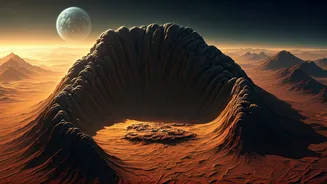
The surface of Venus is adorned with peculiar circular formations called coronae, which scientists believe are vital to deciphering the planet's otherwise
obscure internal workings. Anna Gulcher, an earth and planetary scientist from Germany's University of Freiburg, has pioneered innovative 3D models of the largest of these coronae. These models are built upon data painstakingly gathered by NASA's Magellan spacecraft, which concluded its mission in 1994. By analyzing the radar sensor data from Magellan, Gulcher's team has gained a more detailed understanding of the topography and gravitational signatures surrounding these massive structures. The diversity observed in the size, shape, elevation, gravity readings, and tectonic settings of these coronae strongly suggests that they are not the product of a single, uniform process. Instead, they represent a range of dynamic geological events, as outlined by Gulcher and her colleagues in a presentation at the European Geosciences Union's 2026 General Assembly in Vienna. This ongoing research aims to bridge the gap in our knowledge about Venus' complex geodynamics, a subject that has long puzzled planetary scientists.
Plate Tectonics: Earth vs. Venus
A central debate among planetary scientists revolves around whether Venus has ever experienced a geophysical process akin to Earth's atmospheric carbon recycling, particularly through full-scale plate tectonics. This theory posits that our planet's lithosphere is divided into colossal moving plates. Their interactions, including collisions, are responsible for seismic activity, volcanic eruptions, and the continuous cycling of carbon into and out of the atmosphere. Earth's fortunate evolution of plate tectonics has been crucial in maintaining a stable atmosphere over billions of years, a factor arguably indispensable for the development of intelligent life. Gulcher explains that on Earth, carbon is efficiently returned to the mantle, partly due to the presence of vast surface oceans that formed hydrous rocks. These water-rich rocks are significantly more pliable than the lithospheric rocks found on a dry planet like Venus. In fact, it's a significant enigma that Venus may never have possessed such extensive water oceans, a question that future missions to the planet are poised to address. It is now theorized that these oceans are essential for creating plate boundaries, making lithospheric rocks more malleable and thus prone to fracturing and separating into movable tectonic plates. Conversely, in the absence of oceans, Venus likely experienced very limited carbon recycling through tectonic and resurfacing activities.
Future Missions and Insights
The ongoing scientific quest to understand Venus is poised for significant advancements with upcoming dedicated missions. Projects such as VERITAS and EnVision are designed to provide an unprecedented level of detail regarding the surface and subsurface structure of Venus. These missions will offer greatly enhanced topographic and gravity resolution, allowing scientists to analyze the enigmatic coronae with much greater precision. Gulcher and her colleagues highlighted this in a 2025 publication in the journal JGR Planets, underscoring the potential of these future endeavors. The current data, though invaluable, has limitations. The Magellan spacecraft's radar sensors, while instrumental, captured images decades ago. The new 3D models are essential for bridging the gaps in our understanding. The study also points out that current gravity data might overlook many active tectonic signals, suggesting that Venus' geological activity could be far more widespread than currently detectable. This implies that many phenomena on Venus might remain hidden until more sophisticated instruments can probe the planet's surface and interior with greater sensitivity and resolution.
Coronae Formation Mechanisms
The remarkable circular nature of Venus' coronae is believed to stem from their origins deep within the planet. Scientists hypothesize that these features are formed by something circular originating from the interior, such as a massive magma plume. This plume, being hotter than the surrounding material, can exert significant upward pressure on the crust, leading to the formation of the distinctive ring-like structures observed. The coronae are generally thought to be the consequence of substantial mantle convection. Mantle convection refers to the movement within a planet's mantle, the rocky layer situated between the core and the crust. This outward spreading of material can drive the lateral movement of tectonic plates. Essentially, it's a cyclical process of upward and downward movement of mantle material occurring over vast geological timescales. Understanding these deep-seated processes is paramount not only for deciphering Venus' geodynamic regime but also for assessing whether similar mechanisms might have been at play on the early Earth. By integrating gravity and topographic data with sophisticated geodynamic simulations, researchers are identifying potential warm mantle upwellings beneath numerous coronae, providing compelling evidence for diverse plume-related tectonic activities on Venus.