




Earth's Orbital Cleanup
As the expanse around our planet becomes increasingly cluttered with defunct satellites and remnants from early space exploration, scientists have identified
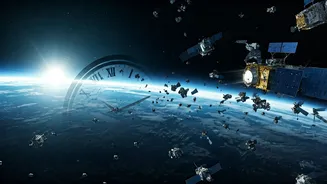
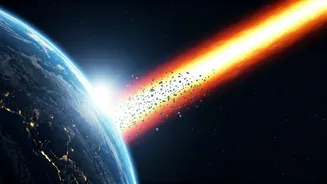
a fascinating natural process for clearing this orbital debris. Research published in Frontiers in Astronomy and Space Sciences indicates that periods of heightened solar activity function like an 'orbital broom,' significantly accelerating the rate at which these space junk particles re-enter Earth's atmosphere. A study examining 36 years of data by researchers at the Vikram Sarabhai Space Centre has pinpointed a critical juncture in solar activity – approximately 67 percent of the solar cycle's peak – at which orbital debris experiences a rapid descent. This revelation offers a vital tool for space agencies, enabling them to better predict and manage the complex dynamics of orbital traffic, thereby potentially extending the operational lifespan of future satellite missions and reducing the risk of catastrophic collisions in our increasingly congested near-Earth environment.
Solar Activity's Impact
The primary driver behind this celestial 'cleanup' is the dynamic expansion of Earth's thermosphere. When the Sun experiences a surge in activity, it releases substantial amounts of ultraviolet radiation and energetic charged particles. This influx of solar energy heats the planet's upper atmosphere, causing it to swell and extend further into space. Consequently, this atmospheric expansion leads to increased friction on objects positioned in low-Earth orbit (LEO). As these objects encounter greater drag, their orbital velocity diminishes, causing them to lose altitude. Eventually, this gradual descent culminates in their fiery demise as they re-enter Earth's atmosphere, effectively removing them from orbit and reducing the overall debris count.
Orbital Decay Acceleration
Groundbreaking research, spearheaded by Ayisha M Ashruf and her dedicated team, has meticulously analyzed the orbital trajectories of 17 objects launched into space between 1962 and 1989. Their findings, published in Frontiers, reveal a non-uniform pattern in orbital decay; it does not progress at a consistent pace. Instead, the rate of orbital decay dramatically intensifies once solar activity reaches a specific threshold. Precisely, when the solar flux achieves around 67 percent of its maximum value within a given solar cycle, space junk experiences a marked acceleration in its descent towards Earth. This identified 'tipping point' is invaluable, serving as a precise marker for scientists to determine the commencement of the solar cycle's debris-clearing phase, offering predictability for space environment management.
Fuel Management Insights
Understanding the timing of these solar-induced orbital clearance events is of paramount importance for the operation of contemporary space infrastructure, including vast satellite constellations like Starlink and OneWeb. During periods of atmospheric expansion driven by solar activity, operational satellites encounter increased atmospheric drag. This forces them to expend additional onboard fuel reserves simply to maintain their programmed orbits and operational altitudes. The discovery of the 67 percent threshold significantly enhances the capabilities of mission controllers. They can now implement more accurate fuel management strategies and refine collision avoidance protocols, particularly vital given the rapid shifts in debris density observed during solar maximum periods, thereby ensuring mission longevity and safety.
Collision Chain Prevention
The comprehensive study utilized a remarkable archive of observational data, meticulously tracking objects that were part of the earliest phases of space exploration. By observing these objects across three distinct solar cycles, each spanning approximately 11 years, researchers gained profound insights into how long-term variations in solar activity influence the orbital behavior of defunct spacecraft. The Vikram Sarabhai Space Centre (VSSC) provided the most in-depth analysis to date, underscoring the Sun's critical role as a natural defense mechanism against the Kessler Syndrome. This hypothetical scenario posits that space debris could accumulate to such a density that it triggers a cascading series of destructive collisions, rendering Earth's orbits unusable.