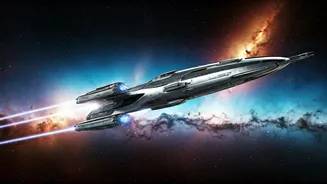

Foundation's Approach
The Foundation series, penned by Isaac Asimov, presents a vision of space travel that leans towards the practical. While not without its futuristic elements,
the series primarily employs conventional methods, with spaceships traversing the vast distances of space. While the specifics of their propulsion systems are rarely delved into, the narrative maintains a sense of groundedness, focusing on the human element and the impact of galactic events rather than fantastical travel mechanics. This approach makes their space travel appear relatively less ridiculous, relying on concepts that, while advanced, are rooted in scientific possibility.
Star Trek's Warp Drive
Star Trek, a cornerstone of the sci-fi genre, introduced the iconic warp drive. This technology allows starships to travel faster than light, bending space-time to bridge immense distances. The warp drive, while a staple, pushes the boundaries of current scientific understanding, making the concept quite imaginative. The core of this technology involves manipulating the fabric of space-time, a concept that is currently theoretical. Despite its imaginative nature, Star Trek's warp drive is presented with a degree of scientific rigor, making it a relatively less outlandish mode of travel compared to others.
Star Wars' Hyperspace Jumps
Star Wars presents the concept of hyperspace, a realm where ships can travel at speeds far exceeding light, enabling intergalactic journeys. The vehicles enter hyperspace by carefully navigating through complex calculations and precise maneuvers to avoid collisions. The transition into hyperspace involves a visual effect of streaking light. While providing convenient travel within the Star Wars universe, the mechanics are largely undefined, relying more on narrative convenience than scientific principles. This lack of rigorous explanation, combined with the instantaneous nature of these jumps, places it higher on the ridiculousness scale.
Stargate's Wormholes
The Stargate franchise employs a system of wormholes to traverse the cosmos. The titular Stargates create stable portals, enabling rapid travel between distant locations. These wormholes represent a more direct approach to instantaneous travel. The mechanics of the wormhole, and the process to stabilize and control them, are often simplified for the sake of the story, making them appear somewhat less grounded in reality. The reliance on advanced alien technology and the precise nature of the dialing sequences also add a layer of complexity to the overall concept.
Doctor Who's TARDIS
Doctor Who's TARDIS (Time And Relative Dimension In Space) embodies the pinnacle of sci-fi travel, utilizing both space and time for exploration. The TARDIS can travel anywhere in the universe at any point in history. The internal dimensions are larger than the exterior appearance would suggest, representing an advanced manipulation of space. The TARDIS's unpredictable nature and its ability to access any point in spacetime make its travel method highly unconventional and on the more ridiculous side. The TARDIS's capability to instantly move the Doctor and his companions across both space and time without any constraints on distance or duration adds greatly to its unique characteristics.