




Gigantic Sunspots Emerge
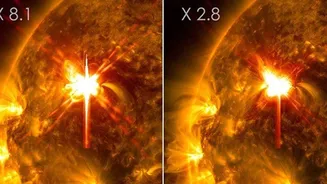
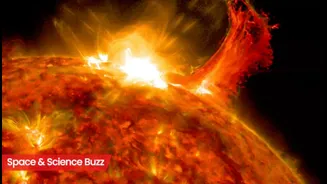
Our star, the Sun, has recently exhibited a remarkable increase in activity, most notably with the appearance of colossal sunspots. One such sunspot, region
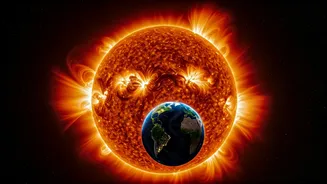
4366, has been particularly noteworthy, being comparable in size to the one responsible for the infamous Carrington Event of 1859. This monstrous solar feature has been directly facing Earth, raising concerns due to its potential to unleash powerful solar flares and coronal mass ejections. Scientists are closely monitoring this region, which has already fired off dozens of potent flares, including the most intense solar eruption recorded in recent years. Its continuous activity and persistent presence indicate a significant and ongoing period of heightened solar emissions.
Solar Storms Unleashed
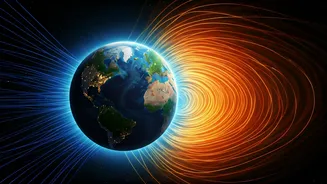
The increased solar activity has manifested as severe solar radiation storms, with one of the biggest in 23 years recently striking Earth. This event was so significant that it triggered spectacular auroral displays, visible not only in their usual polar regions but also extending as far south as California and even Florida. These storms are a direct consequence of powerful solar flares and coronal mass ejections, where large amounts of plasma and magnetic field are ejected from the Sun's atmosphere. The energy and particles from these events travel through space and can interact with Earth's magnetosphere, leading to geomagnetic storms and the captivating Northern Lights. Experts warn that we are approaching a period of intensified space weather, potentially even exceeding the typical extremes of solar maximum.
The Sun's Cycle
The Sun operates on an approximately 11-year cycle, characterized by periods of low activity (solar minimum) and high activity (solar maximum). We are currently transitioning into a more active phase of this cycle, a process described by some as the sun 'slowly waking up.' NASA scientists have cautioned that this increasing activity could lead to more extreme space weather events for decades to come. This heightened period of solar activity means a greater likelihood of significant solar flares, coronal mass ejections, and associated solar storms. Understanding the Sun's rotation, which takes about 25 Earth days at the equator and longer at the poles, is crucial for predicting when active regions will face Earth. The dynamic nature of the Sun ensures a constantly evolving celestial environment.
Impact on Earth and Future Eclipses
The recent solar radiation storm had a tangible impact on Earth, causing widespread auroras and serving as a stark reminder of our planet's vulnerability to solar activity. Beyond the immediate effects of storms, the Sun's behavior also influences other celestial events. For those interested in astronomical spectacles, the next few years promise remarkable opportunities to witness total solar eclipses. Two significant events are anticipated within the next two years, with one being hailed as the 'eclipse of the century.' These celestial alignments, though not directly related to solar storms, offer profound opportunities to observe the Sun's corona and appreciate the grand scale of our solar system. The increasing solar activity, however, does necessitate a vigilant approach to space weather forecasting and preparedness.