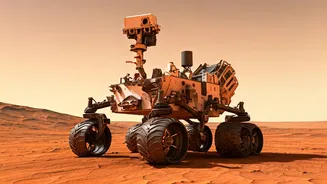

Martian Time Dilation
The fundamental aspect of human exploration on Mars revolves around a less obvious yet critical challenge: the difference in time. Mars, being farther
from the sun and experiencing a different gravitational pull, has a slightly longer day, known as a sol. A Martian sol lasts approximately 24 hours and 39 minutes, a difference that, while seemingly minor, accumulates significantly over extended missions. This temporal discrepancy impacts everything from crewed mission planning, scheduling of operations, and communication delays with Earth, to the very biological rhythms of astronauts. Adapting to these altered timeframes requires careful consideration in mission design, astronaut training, and the development of sophisticated timekeeping systems that reconcile Martian and Earth time. Understanding and managing these time differences is paramount for the success and safety of any long-term human presence on the Red Planet, influencing everything from daily routines to critical mission timelines.
Lunar and Solar Frontiers
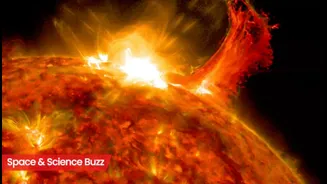
Beyond Mars, humanity's gaze is also fixed on the Moon and the Sun, with significant advancements in observational technology. NASA's Pandora telescope, building on the legacy of the James Webb Space Telescope, is poised to enhance our search for potentially habitable exoplanets. Simultaneously, astronomers have detected 'time-warped' supernovas, celestial events whose light exhibits peculiar characteristics, suggesting complex phenomena at play in the universe. Closer to home, the Sun has presented its own dramatic spectacles, with a giant sunspot comparable to the one that caused the historical Carrington Event appearing and orienting towards Earth. This has spurred advancements in solar storm prediction and mitigation strategies. The Moon also remains a focal point, with detailed lunar calendars for 2026 outlining the appearance of all 13 full moons, offering opportunities for continued observation and scientific study.
Navigating Space Missions
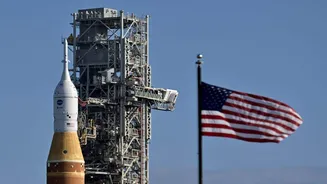
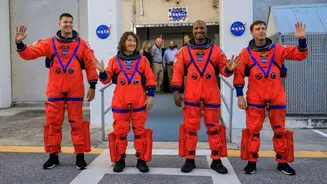
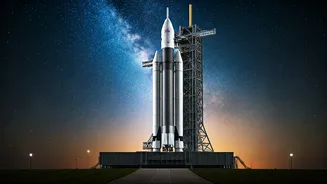
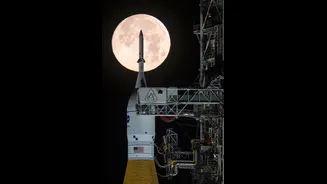
Recent events highlight the complexities and risks inherent in space exploration, from emergency returns to ambitious program shifts. The emergency return of Space Crew-11 underscored the critical need for robust contingency planning in orbital missions. In parallel, the cancellation of the Mars Sample Return initiative has paved the way for other nations, like China, to pursue the retrieval of Martian samples, signaling a dynamic geopolitical landscape in space science. On the lunar front, NASA's Artemis II mission has seen significant preparation, including the rollout of its massive moon rocket and simulated launches, despite facing delays due to weather conditions like a rare Arctic outbreak. This mission represents a crucial step towards returning humans to the lunar surface. Furthermore, Blue Origin's New Glenn rocket has its own launch window for a historic Mars mission adjusted due to a solar storm, demonstrating the constant interplay between human endeavor and cosmic phenomena.
Technological Leaps & Earthly Insights
The realm of science and technology continues to yield fascinating discoveries and innovative tools, impacting both our understanding of the cosmos and our daily lives. NASA's powerful new Roman Space Telescope is now complete, set to embark on a mission to identify approximately 100,000 alien worlds. This advancement in exoplanet detection promises to revolutionize our understanding of planetary diversity. On Earth, historical artifacts like the Ribchester Helmet, a remarkably preserved Roman cavalry officer's helmet from 1,900 years ago, offer tangible connections to our past. In archaeology, innovative techniques using aerial lasers to map sites are being developed, though they raise important questions about Indigenous partnership and consent. Even the common cold, a familiar ailment, is being demystified through 'nose-in-a-dish' research, revealing why its severity varies among individuals. These diverse advancements underscore the multifaceted nature of scientific progress.