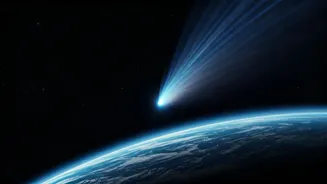

Comet's Grand Voyage
The interstellar comet 3I/ATLAS has been on a long journey, hurtling through space to reach our vicinity. It is not a resident of our solar system; instead,
it originated from another star system, making its close approach to Earth a notable event. This visit presents a rare chance to examine a cosmic object from beyond our solar neighborhood, a chance which offers a direct look at materials that predate the formation of our own system. The comet's trajectory is carefully monitored, and astronomers around the globe are preparing their instruments to capture the data that it will offer. This encounter helps expand knowledge of celestial mechanics and the possible diversity of planetary systems beyond our own. The comet's composition, its behavior, and its interaction with the solar wind are all subjects that will be studied intensely during this period.
Observing the Comet
When the interstellar comet 3I/ATLAS comes closest to Earth on December 19th, skywatchers with the right equipment can look forward to a possible celestial display. Telescopes and high-powered binoculars may offer good viewing opportunities. Observers must know the night sky and light conditions in the area they are in. The comet's brightness and visibility depend on its size, composition, and the viewing conditions at the time. Scientists will use a variety of tools, including ground-based observatories and space telescopes, to study the comet. These instruments allow them to collect data on the comet's light, gas, and dust emissions, providing critical details about its composition and activity. The gathered data helps us understand the composition of interstellar space and the early stages of our solar system.
Scientific Significance
The arrival of 3I/ATLAS offers a treasure trove of scientific opportunities. The study of the comet's composition will give insight into the ingredients found in the early solar system. It can help identify the building blocks that formed planets, and perhaps even clues about the start of life. Comets are thought to have delivered water and organic materials to the early Earth. Studying a comet from outside our solar system allows scientists to compare materials from various star systems, which may confirm the universality of the building blocks of life. Studying the comet's orbit and its interaction with the solar wind also provide new insights into space weather and the dynamics of the interstellar medium. The comet's visit will be a significant step forward in our understanding of the universe, offering clues about the origins of celestial bodies and the potential for life beyond Earth.