







Lost World Revealed
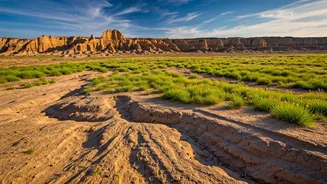
Geological research is currently overturning existing notions of the Arabian Peninsula, demonstrating that it wasn't always a desert environment. Studies
are revealing strong evidence pointing to a radically different landscape in the past, a landscape that included rivers, lakes, and expansive grasslands. This transformation is being uncovered by analyzing ancient sediment layers, which offer clues about the kinds of vegetation and water sources that were once abundant. By piecing together these environmental clues, scientists are reconstructing a picture of a more verdant Arabian Peninsula, far removed from its present-day arid conditions. The findings serve not only as a historical revelation but also provide essential data for comprehending the complex interplay between climate, geography, and biodiversity.
Ancient Ecosystems Explored
The research unveils the existence of complex ecosystems that thrived across the Arabian Peninsula. The analyses of fossils and geological formations highlight how diverse plant and animal life once inhabited the area. The presence of ancient rivers indicates a readily available water supply, which, in turn, supported the proliferation of various species. Moreover, scientists are studying fossil records to identify species, which helps to pinpoint how fauna and flora adapted to the shifts in climate over thousands of years. This exploration offers insight into the dynamics of the ecosystems that contributed to the region's ecological richness. Such studies also help in understanding the effects of environmental changes and offer a window into how these landscapes might evolve in the future.
Climate's Shifting Sands
Understanding the transition from a green Arabia to its current state is closely linked to climate variations. Scientific research focuses on identifying the climatic shifts that drove this change. The analysis of climate patterns, which include changes in rainfall, temperature, and atmospheric conditions, can explain how the environment has transformed. Data from ice cores, ancient sediments, and other geological indicators helps scientists to reconstruct past climate scenarios. This information provides insights into the major factors that led to desertification. The knowledge garnered through such investigations is invaluable for predicting and mitigating the environmental impacts of climate change.
Broader Environmental Context
The findings in Saudi Arabia are being used as part of a larger global effort to understand environmental changes. The research offers a case study of how ecosystems react to climatic changes. The study of the Arabian Peninsula highlights the complex interplay between climate, geography, and biodiversity. Such understanding extends to similar investigations in different parts of the world. Therefore, the implications of these studies reach beyond the geographical boundaries of the Arabian Peninsula. It offers insights into how other regions can undergo similar changes. The lessons learned from the Green Arabia project can support informed policies for environmental protection and sustainable resource management worldwide.