
Europa's Intrigue
Europa, one of Jupiter's many moons, has long fascinated scientists. It is covered in a thick layer of ice, hiding what could be a vast ocean underneath.
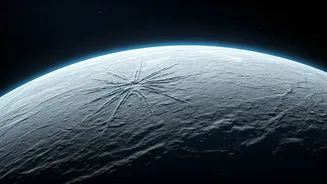
This potential ocean is particularly interesting because it could be a place where life, as we know it, could exist. The discovery of potential saltwater reservoirs is the latest piece of the puzzle. Now, scientists are focused on an unusual feature on the moon's surface: a spider-like formation that is drawing considerable interest. This strange formation might be a clue that there is a subsurface saltwater environment beneath the icy exterior.
The Spider Scar
The so-called "spider scar" is a network of ridges and fractures. Its web-like appearance is now thought to be more than just a surface curiosity. Data collected and analyzed from various space missions, including detailed imagery, is helping scientists understand the scar's composition and formation. The scar may provide pathways for the exchange of materials between the ocean below and the surface. This exchange could mean that chemical compounds and energy sources needed for life might be present near the surface, as well. This connection between the surface and subsurface is a crucial element that scientists are investigating.
Subsurface Oceans
The idea of a subsurface ocean is central to the ongoing research. The possibility of such oceans has led to questions about what is contained inside. If liquid saltwater exists beneath the ice, it could have complex, habitable properties. The presence of water is one of the most fundamental requirements for life. Scientists study water composition, temperature, and any potential chemical reactions in the water. The investigation of Europa's subsurface ocean provides one of the best locations in our solar system to look for life elsewhere. As scientists continue their analysis, the potential for life on Europa becomes increasingly intriguing.
Future Missions
Understanding Europa and its potential for habitability is driving the development of future space missions. These missions are designed to get a closer look at the moon and to gather more data. These missions hope to answer key questions. Are there complex organic molecules in the ocean? What is the chemical composition of the water? Scientists are planning missions with advanced instruments. These instruments can analyze Europa's surface and potentially detect evidence of life. These ambitious projects hope to drill through the ice, and sample the water itself. This work would provide unprecedented insight into Europa's secrets.
Implications of Discovery
The discovery of a possible subsurface ocean has enormous implications. Europa could be one of the most promising locations beyond Earth to discover extraterrestrial life. If the spider scar is connected to this ocean, it might be possible to study the water by analyzing the surface. This connection is key. The more we learn about Europa, the better we can understand what makes a planet or moon habitable. Research on Europa contributes to the larger search for life in the universe. It encourages us to re-evaluate our notions of where life could flourish.