
Dark Matter's Enigma
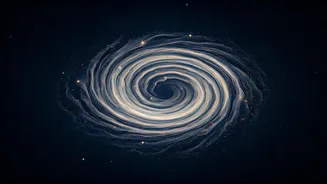
Dark matter, a mysterious substance composing a large portion of the universe's mass, has long puzzled scientists. Because it does not interact with light,
it remains invisible. Instead, its presence is inferred through its gravitational effects on visible matter, such as galaxies. The precise nature of dark matter constituents remains an open question, and its study is crucial for comprehending the universe's evolution and structure. Various hypotheses have been proposed, with some suggesting weakly interacting massive particles (WIMPs) or axions as potential candidates. Despite extensive research and numerous experiments, there have been no direct detections of dark matter particles yet. This lack of confirmation motivates scientists to pursue alternative search strategies, exploring different interactions and characteristics that could unveil its hidden nature. Therefore, understanding its interaction with other particles is critical.
Cosmic Ghost Particles
Cosmic ghost particles, more commonly known as neutrinos, are fundamental particles that only interact via the weak nuclear force and gravity. These particles are incredibly light and travel near the speed of light, making them difficult to detect. Produced in nuclear reactions in the Sun, supernovae, and the early universe, neutrinos are also abundant. Scientists are actively working on ways to detect neutrinos to learn about the processes that create them. The study of cosmic neutrinos offers a unique perspective on cosmic events, which may unveil information about the cosmos that is not accessible through other means. These observations could validate models or suggest entirely new physics, including the relationship with dark matter. The rarity of their interactions requires huge detectors and innovative technologies to capture the signal from their cosmic journey.
Potential Interactions Revealed
The groundbreaking research highlights the possibility of interactions between dark matter and cosmic ghost particles. This could reshape current understandings of fundamental physics and cosmology. If dark matter can interact with neutrinos, it could lead to detectable signals. These signals might manifest as anomalies in neutrino measurements or through indirect detection methods, such as searching for the products of dark matter annihilation. This interaction, if proven, could also provide insight into dark matter's true nature, revealing its mass and its other properties. Analyzing how dark matter particles behave when interacting with neutrinos helps scientists refine existing models, potentially leading to the development of new models. The potential interactions could also reshape existing theories and advance our understanding of how galaxies and other structures formed.
Implications and Breakthroughs
The discovery of an interaction between dark matter and cosmic ghost particles has the potential to trigger a fundamental breakthrough in understanding the cosmos. If confirmed, this interaction will offer critical evidence about the hidden constituents of the universe and how they influence its structure. Scientists can use this as a tool for the indirect detection of dark matter, with the possibility of developing advanced detection techniques. The research could reshape cosmological models, possibly resolving discrepancies between theoretical predictions and observations. It may also provide new insights into the origin and evolution of the universe. The validation of this interaction would validate existing theories about the universe's evolution and possibly help scientists discover new laws that govern the physical world.
Cosmology Questions Raised
The hypothesis about the interaction between dark matter and cosmic ghost particles raises several questions in cosmology. For example, understanding how these interactions influence the distribution of dark matter and visible matter in the universe is essential. Researchers are now more interested in how dark matter affects the formation of galaxies and the cosmic web. The study of these interactions requires detailed simulations and advanced observational techniques to check whether existing cosmological models need revision. This research could open doors to new research areas, as scientists strive to understand the universe's fundamental nature. Answering these questions is critical to refining our comprehension of the universe’s structure and its evolution over time. The answers will contribute to the ongoing quest to understand the universe's ultimate fate.