

Cosmic Web Revealed
Astronomers, utilizing the unparalleled capabilities of the James Webb Space Telescope (JWST), have successfully pieced together a detailed reconstruction
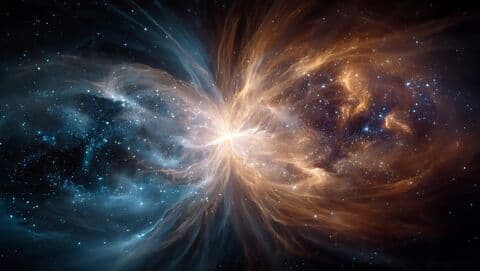
of the universe's underlying structure, often referred to as the "cosmic web." This monumental survey represents the most comprehensive mapping of this cosmic framework to date. The resulting detailed map allows us to trace the evolutionary journey of galaxies from the universe's nascent stages, approximately 13 billion years ago, through to their current arrangements, illustrating how they coalesce into this vast, interconnected network. The cosmic web itself is the most extensive known structure, acting as the primary framework for the entire cosmos, housing innumerable galaxy clusters and even clusters of those clusters. It's envisioned as a scaffolding composed of gas filaments, stars, expansive voids, and sheets of dark matter, all contributing to the large-scale organization of the universe as we understand it.
Galaxy Evolution Insights
The newly released COSMOS-Web survey, powered by JWST, provides unprecedented clarity on the large-scale structure and evolution of the universe. This advanced telescope has resolved what were previously indistinct celestial smudges into discernible, ancient galaxies, offering a much clearer picture than ever before. Researchers have been able to peer into an era when the universe was merely a few hundred million years old, a period that was largely inaccessible to previous observational technologies. This leap in both depth and resolution is truly significant, allowing for a more granular understanding of cosmic development. The survey highlights how the environment surrounding galaxies plays a crucial role in more recent cosmic epochs, often by quenching star formation. This environmental influence can either strip galaxies of essential material or impede the accumulation of cold gas necessary for stars to coalesce and ignite.
Mapping the Framework
The groundbreaking COSMOS-Web project, the most extensive JWST survey undertaken, spans a continuous celestial area equivalent to about 5.7 times the size of the full Moon. This ambitious initiative involved an impressive 255 hours of observation time. When contrasted with earlier surveys, such as the COSMOS2020 effort conducted with the Hubble Space Telescope, the JWST-derived COSMOS-Web exhibits superior redshift precision and catalogues a greater number of galaxies. Crucially, it includes fainter, lower-mass, and more distant objects that were previously challenging to detect. Redshift, a key metric for gauging cosmic distance and the passage of time, is measured by the shift of light towards redder wavelengths as it travels across the universe. While earlier maps were more generalized, the JWST data offers a remarkably refined view, allowing scientists to map the intricate cosmic web with a level of detail previously unattainable.
Star Formation Dynamics
JWST's detailed cosmic map meticulously preserves the relative contrast across different cosmic regions, revealing fascinating dynamics of celestial birth and demise. A key finding is that massive galaxies situated within dense environments tend to be quiescent, meaning their star-forming processes have effectively ceased. The research team posits that this phenomenon may be linked to their immense mass. Once the dark matter halos that anchor these galaxies accumulate to approximately 1 trillion solar masses, they become sufficiently energetic to inhibit the formation of new stars by heating surrounding gas. Furthermore, the energetic jets emanating from active supermassive black holes at the centers of these galaxies also play a significant role in quenching star formation. These mass-related mechanisms appear to have been the dominant forces behind the shutdown of star formation up until roughly 7 billion years ago, which is about half the current age of the universe.