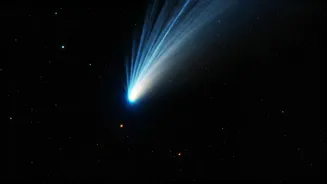

Comet Discovery Unveiled
The European Space Agency's (ESA) Juice spacecraft, intended for exploring Jupiter's icy moons, delivered striking images of Comet 3I/ATLAS. These observations
took place in November 2025, utilizing five scientific instruments to gather crucial data on the comet's behavior, formation, and components. The goal was to understand the features, trajectory, and distinct characteristics of this visitor from beyond. In addition to the other instruments, Juice's NavCam provided an initial visual of the comet, showing its shape, surface details, and areas where it might be releasing gas. These images served as a preliminary view for researchers, preparing them for the more detailed information collected by the other instruments. These observations are a significant step in studying distant comets and improving our comprehension of objects from beyond our solar system, with a mission that was originally designed to explore the distant moons of Jupiter.
NavCam's Early Glimpse
Juice's NavCam, designed primarily for navigation, unexpectedly captured images of Comet 3I/ATLAS. During November 2025, the spacecraft focused its attention on the comet. The observation occurred near Juice's closest approach to the comet, at a distance of approximately 66 million kilometers. Although complete measurements from the scientific instruments are expected in February 2026, the mission team released a single NavCam image as a preview. This preliminary view of the comet revealed a bright coma, indicating activity, much to the excitement of the scientists. The image displayed a glowing halo of gas surrounding the comet, a clear sign of its activity. It also showed two distinct tails: a plasma tail and a fainter dust tail. These characteristics are common among comets as they warm up when nearing the Sun, releasing gas and dust into space. The observation took place shortly after the comet's closest point to the Sun, signifying that 3I/ATLAS was very active. Scientists anticipate that the data from the scientific instruments will provide even more details about these processes, including the composition and behavior of the cometary material.
Scientific Instruments Deployed
Juice employed five specialized instruments to study 3I/ATLAS. These instruments were activated to learn more about the comet. The first instrument was JANUS, a high-resolution optical camera that captured detailed images of the comet's surface and tail formations. Next, MAJIS was used; a spectrometer that analyzed the light emitted and reflected by the comet, to learn its chemical composition. The UVS (Ultraviolet Spectrometer) helped detect specific gases in the coma. The SWI (Sub-millimetre Wave Instrument) provided information on the comet's temperature and molecular composition, and PEP (Particle Environment Package) measured charged particles around the comet. These tools work in tandem to give researchers a deeper understanding of comets and their composition.