
The Shifting Sands
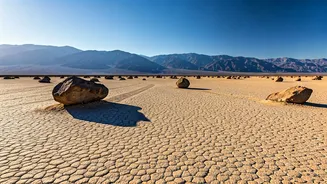
The phenomenon of moving rocks in Death Valley, a desolate location in California's Mojave Desert, had long been a source of wonder and scientific curiosity.
These rocks, some weighing hundreds of pounds, seemed to glide across the flat, dried-up lakebeds of Racetrack Playa, leaving trails in their wake. The lack of direct observation of the movement had, for a long time, fueled numerous theories, ranging from the plausible to the fantastical. These theories included everything from magnetic forces to alien intervention, but none offered a fully satisfactory explanation that aligned with observable evidence. Despite the many hypotheses, the true mechanisms behind the rock's motion remained elusive for an extended period.
Ice and Wind Dance
The breakthrough came with a study, led by scientists at the Scripps Institution of Oceanography, which finally unveiled the truth. The team’s efforts included the installation of GPS units on the moving rocks. These devices, along with time-lapse photography, meticulously tracked the rocks' movements. The study revealed a complex interplay of environmental factors. The specific conditions required for the movement involved the formation of thin ice sheets during winter nights. As the sun began to warm the playa, these ice sheets would thaw, creating a surface where the rocks could float. Strong winds, characteristic of the area, then propelled the rocks across the slippery surface. It's the combination of ice and wind that enabled this movement, debunking earlier theories.
A Unique Combination
The research identified a set of unique conditions that must converge for the rocks to move. Firstly, the playa must flood, leading to the formation of a shallow lake. As temperatures drop during the winter months, the water freezes, creating thin, floating ice. The ice sheets had to be just right—thin enough to allow the rocks to move across them, but also strong enough to support the weight of the rocks without breaking apart. Finally, a gentle push from the wind was needed to set the rocks in motion, allowing them to glide across the ice-covered surface. This delicate balance of conditions provides insight into the movement of the rocks in Death Valley. The research highlighted how seemingly minor environmental variations can produce significant geological events.
Unveiling the Mystery
The scientists' innovative research methods, which combined GPS tracking and visual observation, provided evidence that answered a long-standing scientific puzzle. The study confirmed that wind and ice play critical roles in rock motion. This discovery provides a vivid demonstration of how environmental forces can shape the landscape in unexpected ways. The findings not only resolved the mystery of Death Valley's moving rocks but also underscored the effectiveness of integrating modern technology into geological research. It serves as an example of how persistent observation and innovative techniques can unlock nature's secrets. This research offers valuable insights into Earth's dynamic processes.