
Dark Matter Unveiled
Dark matter, constituting a significant portion of the universe, is a challenging subject to study. It neither emits nor absorbs light, making it invisible
to conventional telescopes. Its existence is inferred through its gravitational effects on visible matter, such as galaxies. Scientists have developed various theoretical models for dark matter, including Weakly Interacting Massive Particles (WIMPs) and axions. Directly detecting dark matter particles remains a challenge, leading to ongoing research and development of more sensitive instruments and techniques. Observing the gravitational lensing effects of dark matter on light emitted from distant objects is another crucial approach, allowing researchers to map its distribution and properties within galaxy clusters and other cosmic structures. The JWST's unique observational capabilities may soon yield more information.
JWST's Powerful Role
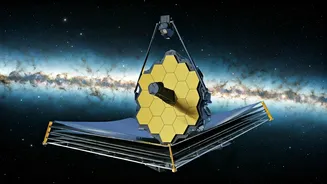
The JWST is playing a crucial role in the ongoing search for dark matter, offering capabilities that surpass previous space telescopes. The telescope's infrared vision allows it to observe distant galaxies with unprecedented clarity. The JWST is equipped with a large mirror, enabling it to collect more light and study fainter objects than ever before, which helps in detailed analysis of the galaxies and clusters. In observing these distant galaxies, JWST can gather data about the distribution of dark matter through its impact on the light from those galaxies. Researchers can analyze the patterns of light to map out the presence and density of dark matter. Further analysis of this data may provide insights into the nature of dark matter particles or refine our models of how dark matter interacts with other components of the universe.
Galactic Collisions Insights
Galaxy collisions can activate supermassive black holes, offering another avenue to study dark matter. When galaxies collide, the gravitational interactions cause changes in the distribution of dark matter. JWST can observe these collisions and the associated effects, giving scientists clues about how dark matter behaves under extreme conditions. By studying the behavior of black holes during these collisions, researchers can infer the presence and distribution of dark matter surrounding the galaxies involved. The Euclid data, with its capacity to map the distribution of dark matter, further complements JWST's observations. Combining data from the JWST and the Euclid mission could provide more comprehensive insights into the role of dark matter in these cosmic events. This combined approach may reveal patterns and correlations that could advance our understanding of dark matter's influence on the evolution of galaxies and the activity of supermassive black holes.
Future Discoveries
The data collected by the JWST may lead to unexpected breakthroughs in our understanding of dark matter. The telescope's ability to observe distant galaxies opens the door to discover new aspects of dark matter. Astronomers are prepared to encounter a number of questions regarding the nature of dark matter and how it impacts the universe. The JWST's observations could uncover details that validate or refute existing dark matter models, potentially leading to the development of new theories. The ongoing collection and analysis of data from JWST is going to be vital for future research. Scientists are eager to see the new data and observations coming from JWST. JWST's continued contributions will be crucial in building a more complete picture of dark matter and its role in shaping the cosmos.