



Cosmic Clutter Concerns
The proliferation of satellites in Earth's orbit is escalating, with plans for millions more in the coming decade. These artificial celestial bodies are
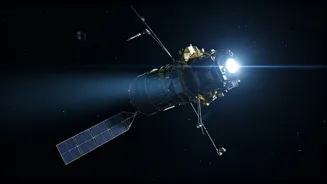
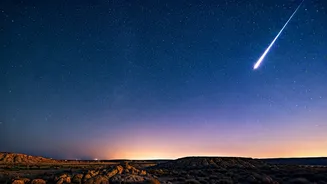
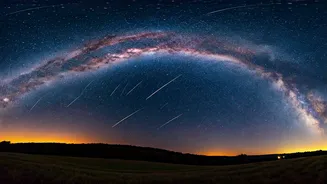
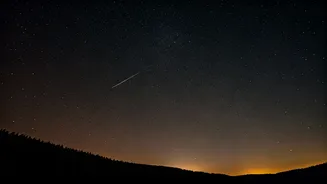
already a nuisance for astronomers, primarily by appearing as unwanted streaks or "photobombs" in sensitive sky imagery. Currently, many satellites visible in Low Earth Orbit can reach an apparent magnitude of 7, which is the faintest brightness detectable by the naked eye. The situation is expected to become considerably more challenging as numerous megaconstellations, comprising tens of thousands of satellites each, are scheduled for deployment. Some of these are problematic due to their sheer size, with certain models being as large as a tennis court. Others, like those designed to use massive mirrors for solar power generation at night, are inherently highly reflective. This combination of factors means these satellites could appear as phantom stars, disrupting delicate astronomical measurements and potentially rendering vast amounts of observational data unusable for deep-space surveys.
Observatory's Data Dilemma
The increasing brightness and reflectivity of satellites pose significant threats to astronomical observations, particularly for instruments like the Vera C. Rubin Observatory. The observatory's sensitive cameras, designed with long shutter speeds to capture faint light from distant cosmic objects, are especially vulnerable. The bright trails left by satellites can not only saturate images but also cause a phenomenon known as "saturation cross-talk," where the light from a streak bleeds into adjacent areas, effectively ruining entire photographs. Furthermore, the light from these bright satellites can scatter off the Earth's atmosphere, creating a pervasive glow that acts as a form of light pollution, obscuring fainter celestial phenomena. A new study employing a sophisticated computer model simulates how visible light scatters through the atmosphere, taking into account two key physical scattering phenomena. This model allows researchers to map the sky's appearance from any terrestrial observatory and predict the precise impact of proposed satellite constellations on specific instruments, such as the Vera C. Rubin Observatory's Legacy Survey of Space and Time (LSST) Camera.
Predicting Satellite Impact
Researchers have utilized advanced modeling to quantify the potential damage of new satellite constellations on astronomical surveys. Even a constellation of 60,000 satellites, if kept dimmer than magnitude 7, could introduce problematic trails that saturate between 6% and 15% of the LSST Camera's field of view, thereby erasing many valuable observations, despite contributing only a small fraction to the sky's natural light. The impact intensifies with larger satellites; for instance, a planned 243-satellite constellation of extra-large mobile broadband satellites would introduce noticeable bright blotches across images. The most dire predictions arise from "superbright" satellites, such as those envisioned by companies planning to use giant reflective mirrors. A constellation of 50,000 such satellites could, according to the model, increase the night sky's brightness threefold, rendering the LSST Camera's data entirely worthless. These findings underscore the urgent need for regulations to mitigate the escalating problem of skyglow from artificial satellites.
Mitigation Strategies Proposed
To safeguard astronomical research, experts recommend strict guidelines for satellite operators. A key suggestion is to ensure most satellites remain fainter than magnitude 7. This can be achieved by applying specialized coatings to the lower surfaces of satellites, directing any reflected sunlight harmlessly into space. This technique, however, is not feasible for satellites designed for reflection, like those using giant mirrors. Another crucial recommendation is to limit the number of satellites brighter than magnitude 7 to fewer than 10 at any given time, as a single bright satellite can have a more detrimental effect than thousands of fainter ones. Experts also suggest capping the total number of satellites in orbit to below 100,000. While not an absolute limit, this figure is proposed as a threshold beyond which astronomical data losses would become comparable to other natural impediments, such as adverse weather conditions, thereby preserving the integrity of crucial cosmic surveys.