






Young Star's Behavior
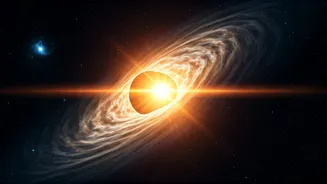
Scientists have recently deciphered the unusual activity of a youthful star situated approximately 1,950 light-years from Earth. Analyzing this star's
unique patterns gives astronomers a glimpse into the dynamic processes occurring in young stellar systems. These findings present an opportunity for deeper studies of the early stages of star development, offering crucial insights into stellar evolution. The research into these complex phenomena helps establish a deeper comprehension of how stars transform and interact within their surrounding environments.
Star Birth in Cloud
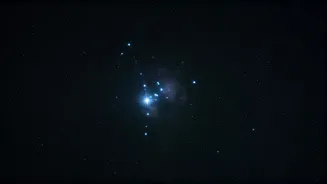
Researchers are focusing on the Large Magellanic Cloud (LMC), a satellite galaxy to the Milky Way, to analyze star creation. The LMC's proximity and substantial star-forming zones make it an optimal target for investigation. By scrutinizing the stellar nurseries within the LMC, astronomers seek to comprehend the process of how stars come into existence and to study the underlying circumstances that drive this process. This effort not only improves understanding of stellar formation but also helps establish knowledge about how galaxies develop and evolve through time. Studying the LMC gives astronomers insights into the conditions that foster stellar birth.
Tracing Dark Matter
Astronomers have utilized runaway stars to trace the distribution of dark matter throughout the Milky Way Galaxy. Runaway stars, ejected from their original stellar clusters, act as cosmic probes, assisting scientists in mapping the enigmatic distribution of dark matter. By observing the motions of these high-velocity stars, researchers can infer the structure and density of the invisible dark matter that comprises a significant portion of the galaxy's mass. This innovative technique presents a fresh way to understand the unseen structure within galaxies. The findings give new perspectives on the unseen characteristics influencing galactic dynamics.