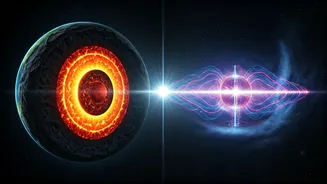








Earth's Shifting Core
Recent research indicates that Earth's solid inner core is not as static as previously believed. Instead, it exhibits surprising 'softness' attributed
to the energetic jostling of atoms. Furthermore, evidence suggests the inner core is not only slowing down its rotation but is also changing shape, exhibiting a lopsided growth that has scientists pondering the underlying mechanisms. These shifts could have subtle yet significant implications for our understanding of planetary evolution and magnetic field generation. The phenomenon of missing lighter elements potentially hiding within this solid core adds another layer of complexity, suggesting our models of Earth's composition may need revision. These dynamic changes challenge long-held assumptions about the stability of our planet's deep interior.
Fusion Energy Advances
The pursuit of near-limitless clean energy has taken a significant leap forward with China's 'artificial sun' reactor, the Experimental Advanced Superconducting Tokamak (EAST). This groundbreaking fusion device has shattered a major limit, sustaining a plasma temperature of 120 million degrees Celsius for an unprecedented 101 seconds. This remarkable achievement represents a crucial step towards harnessing nuclear fusion, the same process that powers stars, as a viable energy source on Earth. Overcoming such high-temperature plasma confinement challenges is vital for making fusion power a reality, offering the potential for a clean, safe, and abundant energy supply with minimal radioactive waste compared to traditional nuclear fission.
Cosmic and Planetary Puzzles
Beyond Earth's immediate interior, scientists are investigating a myriad of cosmic and planetary enigmas. Remarkable findings include the discovery of the world's oldest rock art and a massive reservoir hidden beneath the East Coast seafloor, hinting at ancient geological and potentially human activities. Revelations from black holes continue to challenge our understanding of physics, while a record solar radiation storm underscores the dynamic and sometimes hazardous nature of our sun. On Earth, a critical moment when El Niño began eroding Russia's Arctic sea ice has been identified, providing vital climate data. Elsewhere, an enormous 'mega-blob' of solid rock and iron has been detected deep beneath Hawaii, potentially fueling its volcanic activity, and a colossal helium shortage looms, though ancient rocks may hold undiscovered reservoirs.
Unconventional Scientific Models
Our fundamental models of the universe are facing re-evaluation as new theories emerge. One fascinating proposition suggests that space itself might be a 'sticky' fluid, an idea that could reconcile discrepancies in our current cosmological understanding. In particle physics, interactions between dark matter and neutrinos are being explored, hinting at a potential 'fundamental breakthrough' that could reshape our perception of the universe's building blocks. These unconventional ideas, like the potential for life to have rebounded 'ridiculously fast' after the dinosaur-killing asteroid impact, push the boundaries of scientific thought and encourage a more flexible approach to understanding reality.
Earth's Hidden Resources
Emerging research points to vast, untapped resources hidden within Earth's crust that could revolutionize our energy landscape. Scientists suggest that Earth's crust harbors enough 'gold' hydrogen to power the world for tens of thousands of years. This discovery, coupled with advancements in battery technology like new solid-state sodium-ion batteries designed to make electric vehicles cheaper and safer, highlights a future driven by innovative energy solutions. Furthermore, an electrochemical method that splits water with electricity to produce hydrogen fuel, while significantly cutting energy costs, demonstrates practical steps towards a sustainable energy economy. Even undersea lava rubble is being recognized for its potential as a 'sponge' for carbon dioxide, offering natural carbon capture solutions.