






Smart Robots for Thirsty Trees
Water scarcity is a growing concern for modern farming, pushing for smarter ways to use every drop. Traditional irrigation methods often water all trees
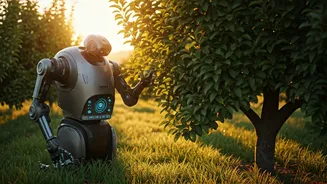
uniformly, leading to significant waste. However, a new era in agricultural technology has dawned with the invention of an intelligent robot capable of discerning precisely which trees require hydration. This innovation moves beyond the broad-brush approach of watering entire fields, instead focusing on individual plant needs. Scientists from Pennsylvania State University have pioneered this system, which involves deploying small, ground-based robots to meticulously map soil moisture levels for each tree. This granular approach acknowledges the inherent variability in soil properties, even between closely situated trees, ensuring that each plant receives the optimal amount of water it needs to thrive, thus ending the 'guessing game' of irrigation.
Precision Irrigation Explained
The heart of this advanced system lies in its ability to eliminate guesswork and introduce precision into irrigation. The robots are equipped with sophisticated sensors designed to measure the electrical conductance of the soil, a highly accurate indicator of moisture content. This data is then calibrated against direct soil measurements to ensure reliability. During trials conducted between October 2024 and March 2025, the researchers achieved remarkable accuracy, reporting a median error of just 0.039 m³/m³ in soil moisture evaluation – a level deemed highly acceptable for practical application. Remarkably, the study found that as few as four to six calibration sites per field were sufficient to maintain these excellent results, significantly reducing the need for expensive infrastructure typically associated with soil moisture monitoring equipment. This automation, driven by sensors, robotics, and algorithms, fundamentally enhances decision-making in agriculture, as highlighted in previous research on automated irrigation systems.
Environmental Benefits & Future
The advantages of this technology extend far beyond mere convenience; they encompass significant environmental and economic benefits. Over-watering can not only squander precious water resources but also contribute to crop diseases, deplete soil nutrients, and damage trees. Precision irrigation, by contrast, ensures that each tree receives exactly the water it needs, which is crucial for maximizing crop yields. As drought conditions intensify globally due to climate change, such systems become increasingly vital. These AI-powered robots enable the cultivation of crops using substantially less water than previously thought possible. Looking ahead, this technology is poised for integration with other innovations, potentially creating fully automated, self-sustaining farm systems. The fusion of artificial intelligence and climate forecasting could further enhance precision irrigation, allowing farms to adapt autonomously to changing weather patterns and achieve a new level of self-sufficiency. Ultimately, this robotic solution demonstrates the profound potential for achieving near-perfection and unparalleled resource efficiency in farming through the strategic application of robotics and advanced technologies.