







A New Vision Emerges
In anticipation of the India AI Summit, an Indian AI venture has unveiled a revitalized brand identity, signaling a renewed commitment to developing AI technologies
tailored for India. This updated persona, characterized by a distinct visual language and a focused mission, emphasizes the creation of tools that resonate with the country's diverse linguistic and cultural landscape. The company's core belief, as articulated in their statement, is in 'AI for all, from India,' aiming to build artificial intelligence systems that deeply understand Indian cognitive processes, communication styles, and problem-solving approaches, all while adhering to stringent global benchmarks for engineering excellence and performance. This strategic reorientation positions the startup to foster AI innovation that is both globally competitive and deeply rooted in Indian context. The name 'Sarvam,' derived from Sanskrit and signifying 'all,' encapsulates this expansive aspiration to serve everyone with AI solutions originating from India.
Symbolic Gateway Design
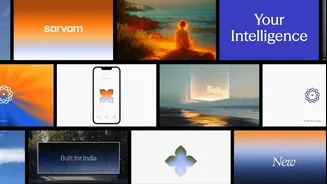
The central theme of the company's new visual branding is the concept of a gateway, ingeniously symbolizing the convergence of human ingenuity and machine capability, as well as the fusion of cultural nuances with computational power. This symbolic representation is further elaborated through a monogram that draws inspiration from the intricate patterns of mandala geometry, forming a layered structure reminiscent of a lotus flower. A deliberate gradient transitioning from blue to orange is employed to visually convey a sense of forward momentum and continuous progress. According to the company, the overall aesthetic is meticulously crafted to evoke a feeling of being both grounded in familiar cultural elements and distinctly modern. This thoughtful design choice has already generated positive discourse, with many observing its clean execution and its deep connection to traditional Indian design principles, noting resemblances to mandalas and even architectural features found in historical Rajasthani forts, which some have praised as an exemplary representation of 'Indic design.'
Innovative Product Suite
Beyond its branding evolution, the company has also made significant strides with recent high-profile product launches, gaining considerable traction within India's rapidly expanding AI sector. One such innovation is Sarvam Vision, an advanced document processing and Optical Character Recognition (OCR) model. This sophisticated tool is engineered to extract textual data not only from printed documents but also from image-based sources, including scanned files and handwritten notes. Its capabilities extend beyond rudimentary text recognition, as it can effectively interpret information embedded in graphs, identify trends within charts, and meticulously preserve complex table structures, even when these tables are nested or visually intricate. Crucially, Sarvam Vision demonstrates robust support for a wide array of 22 Indian languages, encompassing major ones like Hindi, Bengali, Tamil, Telugu, and Marathi. Complementing this is Bulbul V3, a cutting-edge voice technology solution. This text-to-speech system has been meticulously developed with a specific focus on Indian languages and their characteristic speech patterns. Offering a diverse selection of over 35 distinct voices across 11 Indian languages, Bulbul V3 is engineered to adeptly handle the complexities of code-mixing, regional vernaculars, abbreviations, and the varied emotional inflections commonly found in everyday Indian discourse.
Pioneering Sovereign LLM
Looking toward the future, the startup is preparing to achieve a significant milestone by contributing to the development of India's foundational large language model (LLM) ecosystem, having been selected under the India AI Mission for this critical initiative. The company has indicated its intention to release its foundational model in early 2025, potentially preceding or coinciding with the India AI Impact Summit. This ambitious project is informed by a critical observation: existing global AI models are trained on less than 1% of Indian data, creating a significant gap in their understanding and applicability within the Indian context. In contrast, the planned model is slated for training on an extensive dataset of over 17 trillion tokens, with a substantial portion, specifically 17–20%, derived from Indian data sources. This deliberate inclusion of Indian data is intended to ensure the model possesses a nuanced comprehension of the country's languages, cultures, and specific informational needs, aiming to deliver AI capabilities that are both powerful and profoundly relevant to India.