
The Tech Titans
Nvidia's Graphics Processing Units (GPUs) and Google's Tensor Processing Units (TPUs) represent major players in the world of computing, each with distinct
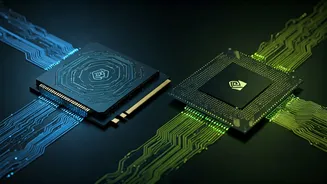
architectures designed for specialized tasks. GPUs, originally made for rendering graphics in video games, have evolved into versatile processors capable of handling complex computational workloads, particularly in fields like deep learning and artificial intelligence. They offer high parallel processing capabilities, making them well-suited for tasks that involve numerous simultaneous calculations. Google's TPUs, on the other hand, are custom-designed hardware accelerators specifically made for machine learning tasks. TPUs are designed with a focus on matrix operations, which are at the heart of many machine learning algorithms. They are optimized for these operations, providing significant performance benefits in specific applications. Both technologies are essential for the advancement of modern computing, but each has its own strengths, applications, and architectural designs.
GPU: Versatility King
Nvidia's GPUs, with their highly parallel processing architecture, boast unparalleled versatility. Originally created for graphics rendering, they have become the go-to choice for various applications, including scientific simulations, video editing, and, most importantly, deep learning. The architecture of a GPU involves numerous cores, which are able to perform many calculations concurrently. This parallel processing capability allows GPUs to efficiently manage large datasets and complex algorithms commonly seen in AI and machine learning. This makes GPUs ideal for training large neural networks and running complex AI models. Nvidia's commitment to continuous innovation in their GPU technology, along with the development of software ecosystems like CUDA, has cemented their position as a dominant force in high-performance computing and is the preferred choice for a vast range of computing needs.
TPU: AI Accelerator
Google's TPUs are custom-designed hardware accelerators with a singular focus: accelerating machine learning workloads. They are specifically optimized for matrix operations, which form the cornerstone of neural network calculations. TPUs are not general-purpose processors; they are designed to excel at matrix multiplications and other operations critical to running machine learning models. This specialized design allows TPUs to outperform GPUs in some specific applications, especially for those that are heavily dependent on matrix computations. Google has integrated TPUs into its data centers and has made them accessible through its cloud services, allowing users to leverage their performance benefits for AI tasks. Their design shows how focused hardware can yield significant improvements in compute-intensive domains, making them an important part of the AI ecosystem.
Performance Face-off
The performance of GPUs and TPUs depends greatly on the specific workloads. In many deep learning tasks, GPUs still hold a significant lead due to their versatility and the well-developed software ecosystems, allowing for broad compatibility and rapid iteration. However, for certain machine learning models optimized for TPUs, Google's custom-designed processors can achieve impressive performance gains. TPUs are particularly good at handling the massive matrix operations required for AI tasks. This performance advantage may make them the preferred choice for specialized applications running on Google's infrastructure. Ultimately, the best choice depends on the specific demands of the workload. Factors such as model type, dataset size, and hardware availability influence the performance landscape, underscoring the ongoing nature of the 'Silicon Wars' and the continued evolution of computing technology.
Ecosystem and Software
Software ecosystems play a crucial role in the adoption and effectiveness of GPUs and TPUs. Nvidia has invested heavily in developing a robust software ecosystem, with CUDA as its cornerstone. CUDA provides developers with the tools and libraries needed to write code that efficiently harnesses the processing power of GPUs. CUDA's widespread adoption has led to an extensive range of applications, libraries, and frameworks optimized for Nvidia hardware. Google, on the other hand, has integrated TPUs into its cloud services, providing users with the tools and infrastructure to easily utilize TPUs. Google also supports frameworks like TensorFlow, and provides optimized versions of libraries. The choice of hardware often comes down to software ecosystem and support, with each company working to give developers the best tools.
Looking Ahead
As technology advances, the competition between GPUs and TPUs is bound to increase. Nvidia continues to innovate with its GPUs, pushing the boundaries of performance and expanding its software ecosystem. Google continues to refine its TPU architecture, seeking to optimize performance for AI workloads and to make them more accessible through its cloud platform. Future developments might include new architectural designs, further software enhancements, and even closer integration between GPUs and TPUs. The 'Silicon Wars' drive innovation and benefit users with better performance and more choices in the realm of high-performance computing. As the capabilities of AI and machine learning expand, the importance of both GPUs and TPUs will only increase, shaping the future of technology.