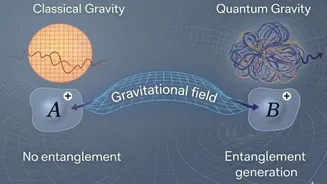









Gravity's Quantum Pace
Recent investigations spearheaded by researchers at the prestigious Indian Institute of Technology Bombay have shed new light on the enigmatic behavior
of gravity at the quantum level. Their findings suggest that gravity might not always exhibit its typical promptness when interacting with quantum phenomena. Instead, it can appear 'sluggish,' almost as if it's functioning as a static backdrop rather than an active force. This peculiar characteristic is a significant development in our understanding of how gravity interacts with the subatomic world, a realm where its influence has been notoriously difficult to observe and measure with precision. The study proposes that this 'slowness' could be the missing piece in explaining why scientists have yet to witness quantum entanglement occurring between macroscopic objects, a phenomenon that has been a long-standing puzzle in physics.
A New Experimental Tool
To probe this fascinating aspect of gravity, the IIT Bombay team has developed an innovative technique they call dynamical fidelity susceptibility (DFS). This new method is not just a theoretical concept; it's designed to be a practical and highly precise instrument for future laboratory experiments. By offering a more refined way to measure and observe gravitational effects in quantum systems, DFS promises to accelerate the pace of discovery. It provides physicists with a sharper lens through which to examine the intricate dance between gravity and quantum mechanics, potentially enabling them to test their theories with unprecedented accuracy and explore the implications of gravity's sluggishness. This advanced tool is expected to be instrumental in pushing the boundaries of quantum physics and cosmology.