





Distant Supernova Glimpse
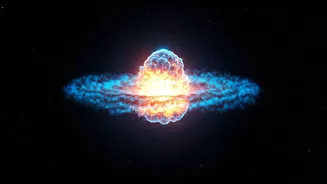
In the realm of space discoveries, the James Webb Space Telescope (JWST) made an extraordinary sighting: the most distant supernova ever observed. This
supernova, originating from 730 million years after the Big Bang, offers a glimpse into the early universe. The JWST's capacity to see light from such a distance provides astronomers invaluable insights into the composition of the universe. This finding allows a clearer grasp of the cosmos's evolution and the emergence of galaxies and celestial bodies. This discovery underscored the advancements in space observation, and the potential for uncovering even more remote and ancient celestial occurrences.
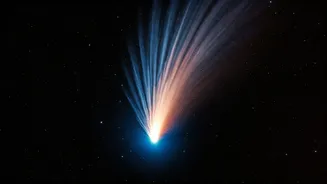
New Comets Unveiled
2025 also delivered the exciting news of the discovery of new comets. These celestial objects, journeying through the solar system, offer scientists a look into the history of the solar system. Each comet provides a window into the formation of our planetary neighborhood, revealing its past. Analyzing their composition and trajectories gives clues about the origins of the solar system and how it has developed over billions of years. These revelations enable scientists to enhance models of celestial body evolution, which is crucial for advancing our space exploration pursuits.
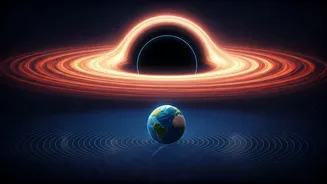
Black Holes Detected
Furthermore, in 2025, space discoveries included the detection of new black holes. These are regions in space where gravity is so intense that nothing, not even light, can escape. Finding black holes provides more understanding of the universe's most mysterious objects. Scientists can investigate how these structures impact their surroundings, and how they evolve over time. This data is critical for understanding the behavior of galaxies and the growth of cosmic structures, enhancing our knowledge of the universe's composition and evolution. These findings highlight the ongoing process of space exploration, driving the development of new technologies.
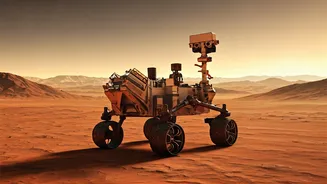
Signs of Martian Life
Another key discovery of 2025 involved the potential signs of life on Mars. While not confirming definitive proof, these intriguing clues spurred ongoing investigations. Scientists detected possible biosignatures in the Martian environment. These biosignatures are chemical or physical indicators suggesting the possible presence of life. These findings, while requiring more research, could change our understanding of life's place in the cosmos. Further expeditions and investigations will be essential for verifying these clues and expanding our knowledge about the possibilities of extraterrestrial life.
Microgravity Experiment Insights
In parallel, in 2025, microgravity experiments conducted on the International Space Station (ISS) yielded valuable insights. These experiments revealed how particles behave in the absence of gravity. Understanding these dynamics is crucial for advancing space technologies. This research aided the design of effective experiments and models, which is vital for building future space habitats. This experimentation also provided unique perspectives on material science, medicine, and engineering. Studying these conditions enhances our abilities to deal with challenges presented by the space environment.