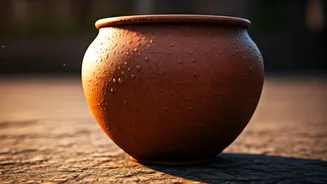







Nature's Chilling Vessel
As the summer sun intensifies, the need for cool hydration becomes paramount. While modern refrigerators offer instant chill, the traditional clay pot,
or 'matka', provides an effortlessly cool respite without any electricity. This ancient vessel, crafted from natural earthen clay rich in silica and alumina, has been a staple for centuries, offering a simple yet profound method for keeping water refreshingly cold. The secret to its efficacy lies not in complex mechanics, but in the inherent properties of the material itself and a fundamental scientific principle that governs our natural world. Understanding how this unassuming pot works offers a glimpse into ingenious traditional wisdom, showcasing a sustainable and eco-friendly approach to beating the heat. The feeling of drinking cool water on a sweltering day is amplified by the knowledge that this cooling comes from nature's own design, a stark contrast to energy-intensive modern appliances. It's a testament to how basic elements can be transformed into effective solutions for everyday comfort and well-being, especially during the peak of summer when temperatures soar.
The Porous Secret Revealed
The magic of the clay pot lies in its unique construction, specifically its unglazed surface. Earthen clay, sourced from riverbeds and comprised of fine mineral particles, is shaped and then fired, but crucially, it remains porous. This means its surface is teeming with microscopic holes, invisible to the naked eye, which are not sealed off. Unlike glazed ceramics, this unglazed texture allows for a subtle interaction with its environment. On a warm day, you might notice tiny droplets forming on the pot's exterior, making it feel slightly damp. This phenomenon is not a sign of leakage or absorption of external moisture, but rather the initial stage of a natural cooling process. The unglazed, porous nature is the fundamental characteristic that enables the clay pot to perform its age-old function of keeping water cool, setting it apart from other types of containers.
Evaporation's Cooling Power
The subtle dampness on the clay pot's surface is the key to its cooling ability, driven by the scientific principle of evaporation. The microscopic pores within the clay allow a small quantity of water to slowly seep through to the outer surface. When this water encounters the warm ambient air, it begins to evaporate, transforming from a liquid into water vapor. This transformation is an energy-intensive process; the water requires heat to change its state. It draws this necessary heat from its immediate surroundings, which includes the water stored inside the pot. As heat is consistently absorbed by the evaporating water on the surface, the temperature of the water remaining within the pot steadily decreases. Essentially, the act of evaporation acts as a natural cooling mechanism, carrying heat away from the pot and its contents, thus ensuring the water stays refreshingly cool, even in the peak of summer's heat.
Optimal Conditions for Cooling
While clay pots are effective in many conditions, their cooling prowess is most pronounced in hot and dry climates. The effectiveness of evaporative cooling is directly influenced by the surrounding air's moisture content. In environments with high humidity, the air is already saturated with water vapor, which significantly slows down the rate of evaporation. Conversely, in dry air, evaporation occurs much more readily and rapidly. This is why clay pots, or matkas, are particularly cherished and feel most effective during dry summer heat. The larger the difference between the water temperature and the air temperature, and the lower the humidity, the more efficient the cooling process becomes. This natural phenomenon highlights how the environment plays a crucial role in enhancing the cooling capabilities of this traditional vessel.
Sustainable Design Principles
The design of a clay pot is a marvel of sustainable engineering, maximizing its cooling potential through simple physics. Its rounded shape inherently increases the surface area exposed to the air, which facilitates a greater rate of evaporation. The natural airflow around the pot further aids this cooling process, carrying away the vapor and encouraging more water to evaporate. What's remarkable is that this entire system operates without consuming any electricity, relying solely on natural processes. This method stands in stark contrast to modern refrigeration, which requires significant energy input. Long before the invention of refrigerators and air conditioners, people understood and utilized basic physics to create comfort during hot weather. The clay pot serves as a timeless reminder that often, the most intelligent and environmentally friendly technologies are the simplest and most readily available.