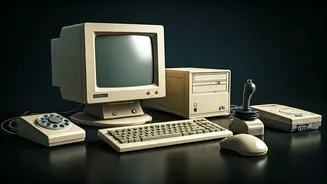

The Rise of PCs
The 1990s witnessed the widespread adoption of personal computers (PCs) in homes. As PCs became more accessible, a variety of accessories emerged to enhance
their functionality and user experience. These accessories went beyond basic computing, enabling users to explore multimedia, gaming, and online connectivity. The surge in personal computer use saw the rise of various add-ons that were both practical and often considered status symbols among the youth of the time. These items changed how many people, especially kids, spent their time. They helped to define the PC experience, making it much more interactive and exciting. The early 90s was all about experimentation, with companies trying to figure out what would stick. This also meant that costs were still relatively high, so the accessories were expensive.
The Dot Matrix Printer
Before inkjet and laser printers dominated the scene, the dot matrix printer was a common fixture in many homes. These printers were known for their distinct 'printing' sound and the use of continuous-feed paper with perforations on the sides. While not known for their print quality, dot matrix printers were inexpensive to operate and very robust. They were often used for printing documents, homework assignments, and even basic graphics. The sound of a dot matrix printer became synonymous with early computer use. It was a clear signal that something was 'printing' or processing. They printed line by line, so printing one single page could take quite a while. These printers were an important part of the 90s computing landscape, even if they're a relic today. They served a key function when PCs were first entering many Indian homes.
Early Computer Mice
The early 1990s saw the proliferation of mice as a standard computer accessory. These were generally two-button mice that connected to the PC via a serial or PS/2 port. The use of a mouse was revolutionary at the time, offering a more intuitive way to navigate the graphical user interfaces (GUIs) that were becoming more common. Before mice, users had to remember commands, so this revolutionized computing. Early mice had a ball mechanism that rolled across the desk to move the cursor on the screen. While not as precise as today's optical or laser mice, they were still a significant improvement over command-line interfaces. Even though the technology has improved, the basic design and usage remain familiar. Mousepads with various designs became common. This small device transformed the way people interacted with computers.
Speakers and Sound Cards
As multimedia capabilities improved, speakers and sound cards became essential accessories. Early sound cards, such as the Sound Blaster series, offered basic sound output. These allowed users to listen to music, play games with sound effects, and experience multimedia presentations. Basic speakers were a must-have for every computer. These upgrades greatly enhanced the entertainment value of computers. As sound card technology advanced, so did the quality of audio output. This development played a key role in the rise of computer gaming and multimedia applications. This enhanced experience made computers more engaging, turning them into centers for entertainment and learning. These accessories changed the experience of using a computer and created new possibilities.
The External Modem
Before high-speed internet, the external modem was the gateway to the online world. These modems connected to the computer via a serial port and to the phone line. They allowed users to dial up to connect to the internet, online services like AOL, or bulletin board systems (BBS). The distinctive screeching sound of a modem dialing up became a familiar sound, signifying connection. Speeds of 14.4kbps, 28.8kbps, and 56kbps were considered high-speed at the time. This limited speed impacted the way people experienced the internet. The external modem was an essential device that connected computers to the internet. This marked the start of the digital age. It was also a slow process, but it opened up new opportunities for communication, information, and entertainment.
CD-ROM Drives
The 1990s marked the rise of CD-ROM drives as a standard accessory. This technology provided a much larger storage capacity than floppy disks, making it ideal for storing software, games, and multimedia content. CD-ROM drives transformed the way software was distributed and installed. CDs eliminated the need for multiple floppy disks. The appearance of CD-ROMs also facilitated the development of more complex and engaging software. They became essential for accessing a variety of educational programs, computer games, and multimedia encyclopedias. These drives revolutionized the way information was accessed. They were quickly adopted as the preferred storage medium.
Joysticks and Gamepads
With the increasing popularity of computer games, joysticks and gamepads became essential accessories for many kids. These devices provided a more immersive gaming experience than using a keyboard and mouse. From flight simulators to platformers, a joystick or gamepad was key to enjoying many popular games. These peripherals allowed for greater control and precision, making gaming more interactive. Early joysticks were simple, with a single button or two. Over time, they evolved into more complex designs with multiple buttons and features. This led to more advanced gaming experiences. As games developed, so did the control options. These gamepads offered an enhanced experience for a wide range of computer games and contributed to the growth of the gaming industry.
Floppy Disks
Although not a new invention, floppy disks remained a crucial storage medium throughout the 1990s. These portable storage devices were used for saving documents, transferring files, and installing software. Floppy disks were relatively small in capacity, with the standard 3.5-inch disks holding 1.44MB of data. Floppy disks were also easily corrupted, which could lead to data loss. Despite these limitations, floppy disks were a practical solution for file transfers and backup. They were a necessary accessory for every 90s kid. They offered a way to share and save data. This simple item played a major role in personal computing.
The Monitor's Impact
Monitors evolved significantly during the 1990s. The size and resolution of displays improved, offering a clearer and more vivid visual experience. Early monitors were large, heavy CRT (cathode ray tube) models. They had limited resolution and color depth. As technology advanced, monitors became flatter, lighter, and capable of displaying a wider range of colors. These display upgrades made computing more user-friendly and appealing. The enhanced visual experience made the computer use better for everyone. These improvements influenced the way people used computers. They also played an important role in making computing more appealing.