





Eyepiece Buying Wisdom
When acquiring telescope eyepieces, prioritize quality above all else; a single superior eyepiece far surpasses a collection of lesser ones. Resist the
urge to immediately opt for high-magnification lenses, as atmospheric conditions, known as 'seeing,' often limit clarity more than the eyepiece itself. Remember that telescopes have an upper limit to their useful magnification. For larger reflector telescopes, allowing them to acclimate to the outdoor temperature for about an hour before use is essential for sharp images. When selecting an eyepiece, comfort and adequate eye relief, particularly for spectacle wearers, are paramount. Attending local astronomy club star parties can be an excellent opportunity to test different eyepieces before making a purchase.
Magnification vs. Power
The perceived 'power' of a telescope is often misunderstood, with magnification being mistakenly prioritized. True telescope capability hinges on aperture, which dictates light-gathering ability, and resolution, which is influenced by aperture and atmospheric stability. Magnification, simply put, is the ratio of the telescope's focal length to the eyepiece's focal length. This means magnification isn't fixed but varies with the eyepiece used. For instance, a telescope with a 900 mm focal length paired with a 20 mm eyepiece provides 45x magnification, while a 10 mm eyepiece yields 90x. Typically, a wider field of view (using the 20 mm eyepiece) is best for initial object location, followed by switching to a shorter focal length (10 mm) for detailed viewing, provided the atmosphere is calm ('good seeing').
Barlow Lens Benefits
A Barlow lens serves as a valuable accessory, effectively extending the utility of your existing eyepieces by increasing the telescope's focal length. This intermediary component, placed between the focuser and the eyepiece, typically multiplies the magnification by 2x or 3x. For example, using a 10 mm eyepiece with a 2x Barlow lens will simulate the magnification of a 5 mm eyepiece, allowing for higher power views without acquiring additional lenses. However, the quality of the Barlow lens is critical. A high-quality Barlow can indeed enhance your eyepiece collection, but a subpar one will only exacerbate the drawbacks of high magnification, such as reduced field of view, dimmer images, and increased sensitivity to atmospheric disturbances.
Choosing Your Eyepiece
There isn't a universal 'best' eyepiece; the ideal choice is dictated by your observational targets. For detailed views of the moon and planets, shorter focal length eyepieces (around 5–10 mm) are recommended. Conversely, for observing distant galaxies, nebulae, and star clusters, longer focal length eyepieces (20 mm or 30 mm) offer a wider, brighter field of view suitable for deep-sky objects. This is because celestial objects vary in their brightness and apparent size. For example, while a 6 mm eyepiece might provide an excellent close-up of a double star, it would only capture the central portion of the Andromeda Galaxy, which is better observed with a low-power eyepiece like a 20 mm. As a general guideline, starting with two to three eyepieces offering low, medium, and high magnification options is wise, with the mid-range eyepiece, approximately 20 mm, often being the most frequently used.
Aperture: The Light Gatherer
While magnification impacts the perceived size of celestial objects, it is the telescope's aperture – the diameter of its main lens or mirror – that fundamentally determines the quality of the view. A larger aperture collects significantly more light, resulting in brighter images, revealing finer details, and enabling the observation of fainter objects like distant galaxies, nebulae, and star clusters. This is why seasoned astronomers emphasize aperture over magnification when selecting a telescope. Physically larger telescopes generally offer superior views of faint, deep-sky objects due to their enhanced light-gathering capabilities. Magnification might allow you to zoom in, but it's the aperture that ensures the zoomed-in image is sharp, detailed, and ultimately worthwhile.
Magnification Limits Explained
The pursuit of higher magnification can be alluring, but it comes with inherent trade-offs. When you increase magnification, for instance by switching from a 20 mm to a 10 mm eyepiece, the resulting image becomes dimmer because the same amount of light is spread across a larger area. Furthermore, any atmospheric turbulence becomes far more apparent, often leading to a blurry or unstable view. A telescope's optical system and aperture impose practical limits on how much magnification can be effectively used. Generally, the maximum useful magnification is considered to be about twice the aperture in millimeters (or 50 times the aperture in inches). Exceeding this limit doesn't reveal more detail; it merely enlarges an already fuzzy image.
Essential Eyepiece Basics
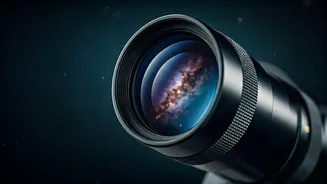
Eyepieces are fundamental components for any telescope owner, attaching to the focuser to dictate the magnification of the view. The process of changing magnification involves swapping out different eyepieces. Once you know your telescope's focal length, you can determine a suitable range of eyepieces to consider. Entry-level telescopes often include two basic eyepieces: one with a focal length of 20-25 mm, and another at 10 mm. A Barlow lens, which typically doubles an eyepiece's power, might also be included. While these bundled accessories are often basic and may warrant an upgrade later, some telescopes are sold without any eyepieces at all. Generally, a longer focal length eyepiece provides a wider, lower-magnification, and brighter view, making it ideal for initially locating and centering celestial objects. Subsequently, a shorter focal length eyepiece can be used for higher magnification, albeit with a narrower and usually dimmer view.