
Digital Twins & AI
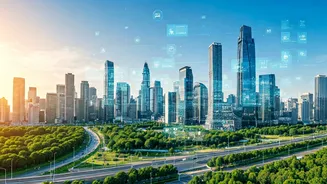
Digital twins and artificial intelligence are revolutionizing how cities operate. Webinars and panel discussions highlight how these technologies serve
as the intelligent operating layer, fostering more efficient urban environments. The Dubai Municipality, for example, has embraced integrated facilities management, showcasing a practical application. Furthermore, the use of AI in personalised government services is increasing, aiming to build trust and inclusivity within cities. Discussions revolve around leveraging AI for creating urban resilience and driving innovation, as seen in projects like the YII 2025 initiative, suggesting that these advanced technologies are not just futuristic concepts but are becoming central to modern city management. This integrated approach signifies a shift towards data-driven governance.
Smart Lighting & Data
Smart lighting plays a crucial role in enabling smart cities, extending beyond basic illumination to facilitate a range of intelligent functionalities. The ability of cities to own their data is equally important. This concept allows cities to maintain control over information generated within their boundaries, enabling them to make informed decisions. An additional element discussed is sovereign AI. This AI framework grants cities enhanced control over data and their digital destiny. It helps in the reduction of congestion, as seen in the Transport for London five-year plan. Moreover, the smart water metering program in Christchurch provides a clear insight into the adoption of technology in resource management.
Resilient Cities Initiatives
The concept of resilience is central to urban planning. Several cities are implementing strategies to prepare for and withstand various challenges, from climate change to resource scarcity. The ‘Resilient Sydney’ strategy, involving 33 local governments, is an exemplary instance of coordinated urban planning. Quezon City's focus on flood and energy resilience showcases proactive strategies. Pathways2Resilience programme is an initiative which aims to build robust urban centres. These resilience efforts also encompass the use of AI, digital twins, and other urban innovations. These projects not only focus on infrastructure but also on community engagement and adaptable urban policies. These strategies emphasise a long-term approach to make cities more liveable.
Sustainability Transitions
Sustainability is a core focus within smart city initiatives. Cities such as Espoo are inviting partners to accelerate their sustainability transition. Latin America is actively driving high-impact urban climate action, indicating a broad commitment to environmental sustainability. The focus is to decrease environmental impact and foster cleaner urban environments. These efforts involve smart solutions for resource management, energy efficiency, and waste reduction. The goal is to create cities that are environmentally friendly. In the UK, councils are working on scaling up local energy programs. Sustainability is addressed by integrating technological innovations, creating a balanced and environmentally sustainable environment for the future.
AI Governance & Mobility
Singapore is leading the way with its governance framework for agentic AI. This framework helps in responsible use and development of AI technologies. The use of mobility data is also changing the shape of cities, providing a deeper understanding. The application of AI and biometrics is actively influencing the future of mobility payments. This technological advancement increases convenience and security. The intersection of AI and mobility is transforming how people move within urban spaces. This includes better solutions for traffic management and accessible transport. This promotes smart, efficient, and inclusive transport systems.